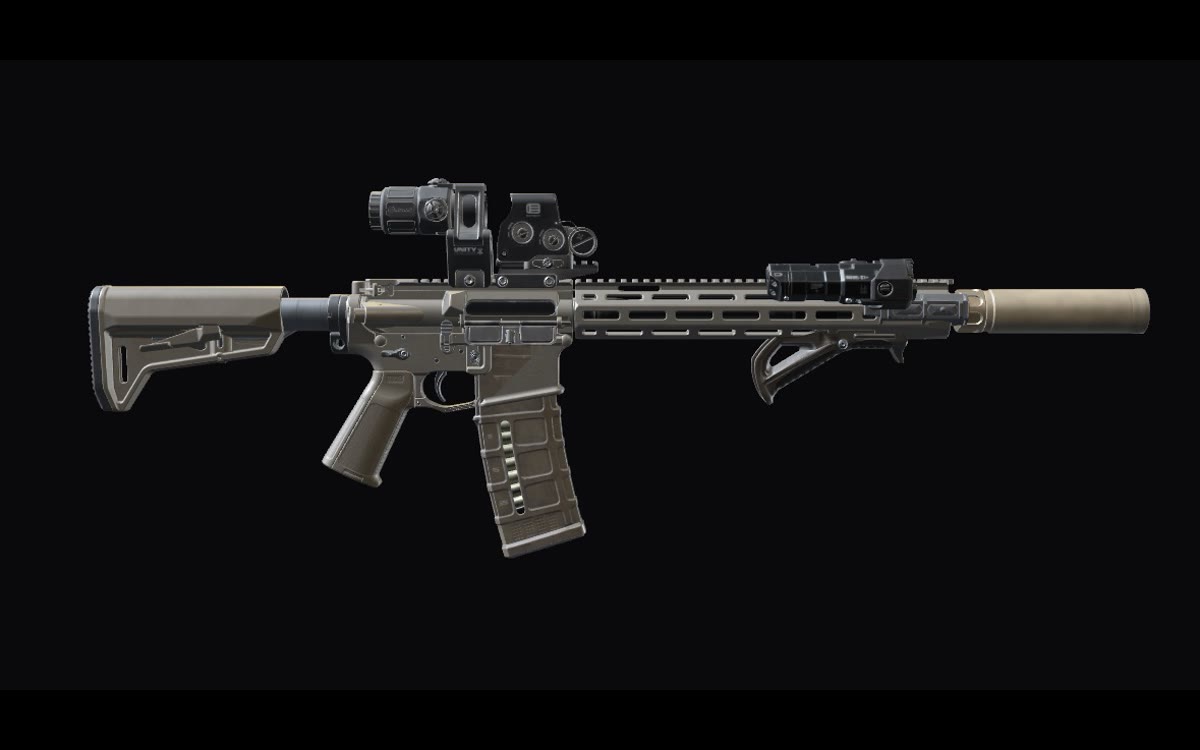
A rifle light is the one accessory that changes what the rifle can do rather than how it shoots. A laser, for the smaller number of people who run night vision, does the same again. Both compete for the same few inches of rail with the front sight, the foregrip and each other, and both want a switch under your thumb that is not where the manufacturer's tail cap put it. This guide covers the numbers that matter when you compare lights, where each device mounts and why, how the switches route, what the laser classes mean for a civilian buyer, and what ships in Gear Guy's catalog under a real name with a price checked at the time of writing.
LUMENS VERSUS CANDELA
Lumens measure total light output. Candela measures intensity in one direction — how far the beam reaches before it fades into the ambient. Two lights with the same lumen number can behave completely differently: a wide flood at 1,500 lumens fills a room and washes out at 50 yards; a tight beam at the same lumens lights a target at 200 yards and leaves the room around you dark. For a rifle, candela is the number that decides whether you can identify what you are looking at across a yard or a field, and it is the one to compare first.
The catalog's lights make the point. SureFire's M600DF runs 1,500 lumens on its 18650 cell (1,200 on two 123As) at 16,000 candela (12,800 on 123As) — a broad, bright pattern built for inside a house and out to the edge of the yard. Modlite's PLHv2-18650 runs about 1,350 lumens, fewer than the SureFire, at about 54,000 candela — more than three times the throw. Streamlight's ProTac Rail Mount HL-X runs 1,000 lumens at 50,000 candela. The compact SureFire M300C runs 500 lumens at 7,600 candela on a single 123A. Read both numbers, and read the candela against where you actually expect to use the rifle.
THE LIGHTS THAT SHIP
- SureFire M600DF Scout Light: $399 at surefire.com. 1,500 / 1,200 lumens, 16,000 / 12,800 candela, 5.15 oz, 5.56″ long, dual-fuel (SF18650B or two 123As), thumbscrew Picatinny mount, Scout tail cap. The most-seen full-size rifle light there is, and the standard the others are measured against.
- Modlite PLHv2-18650: about 1,350 lumens and about 54,000 candela per Modlite, in the 18650 Scout-pattern body. The throw king of the group. Modlite's current rifle package is the PLHv3-18650, listed from $279 at modlite.com; the v2 head in the catalog is the prior generation.
- Streamlight ProTac Rail Mount HL-X: 1,000 lumens, 50,000 candela, fixed Picatinny mount with an M-LOK mount in the box. Primary Arms lists the tape-switch package at $119.99. The best candela per dollar on this list by a wide margin.
- SureFire M300C Scout Light: 500 lumens, 7,600 candela, one 123A, about an hour of runtime, on the M75 thumbscrew mount. The compact Scout body every clone runs; SureFire's site now lists the Mini Scout Light Pro in its place, so the M300C comes from dealer stock.
- Insight WMX200: white light plus an IR illuminator in one AA-powered body from L-3 Warrior Systems, Picatinny mount. A military-issue light that is out of production; it is in the catalog for the GWOT-era configurations it belongs on, and there is no current price to quote.
WHERE THE LIGHT MOUNTS, AND WHY
Three positions cover almost every rifle. Twelve o'clock is the top rail forward of the receiver: the light is centered, throws no shadow from the barrel, and the tail cap or switch falls under either thumb. It is also the most crowded real estate on the rifle. A fixed front sight base owns the front of the top rail, a laser wants it because a laser's display has to be readable from behind the gun, and a deployed flip-up front sight is a third occupant. On a rifle with a laser, the light leaves 12 o'clock.
One-thirty (ten-thirty for a left-hander) is the offset position between the top rail and the side. An offset mount hangs the light just off the top corner, where it clears the front sight, keeps the beam close to the bore, and puts the tail cap under the thumb of a hand wrapped around the rail. It needs a purpose-made offset mount rather than a standard Picatinny or M-LOK foot.
Three o'clock (or nine) is the side rail. The light is out of the way of everything on top, it mounts with any standard clamp, and the beam still clears the barrel on a slim rail. The cost is barrel shadow on the far side and a light that sits under your palm rather than your thumb, which is exactly why the side position is the one that most needs a pressure switch. Six o'clock is for a bipod or a grip, not a light.
Gear Guy models the four rail faces — 12, 3, 6 and 9 o'clock. The offset position between them is not one of the choices on the bench; it is a mount you buy for a light that would otherwise sit at 12.
SWITCHES AND ROUTING
A tail-cap switch works at 12 o'clock and nowhere else. Everywhere else you want a remote pressure switch on the rail under your support-hand thumb, and that raises three questions: how many devices, which plug, and how the cable runs.
A single pad drives one device. A dual pad drives two — one lead to the light, one to the laser — from one clamp, with each pad working separately or together. SureFire's SR07-D-IT ($139 at surefire.com) is the dual pad the catalog carries under its own name: two momentary pads on a snap-on Picatinny clamp, a 7″ cable, one lead for a SureFire WeaponLight and the other for an ATPIAL or DBAL laser. It is the physical form of the light-plus-laser setup this whole article is about.
Plugs are proprietary by family. A SureFire Scout tail cap takes SureFire's plug, and Modlite bodies use the same one; Streamlight uses its own; lasers use their own remote port. A switch bought for the wrong body does not fit, so buy the switch after the light and check the plug on both ends. Route the cable along the rail, not across it, and capture it under an M-LOK cover or a rail panel so it cannot snag or pull the plug.
A remote switch on a rifle with no device that accepts one is a cable to nowhere. Gear Guy's compatibility engine says exactly that: equip a switch with no remote-capable light or laser and it warns, "A remote switch needs a weapon light or laser with a remote-switch port. No equipped device accepts one," and lists the catalog's remote-capable hosts.
LASERS: CLASS, AND CIVILIAN VERSUS MIL
A rifle laser is three emitters in one housing: a visible aiming laser, an infrared aiming laser, and an infrared illuminator. The visible laser is the only part useful without night vision. The IR laser and illuminator are invisible to the eye and exist entirely for a shooter wearing a night-vision device; without one they do nothing.
The line between the civilian unit and the issue unit is output power, set by the FDA's laser classes. Issue devices — the Class 3B AN/PEQ-15 the ATPIAL-C is based on, the full-power OGL — are restricted to government and law-enforcement sale. Civilian units carry Class 1 infrared lasers (about 0.7 mW, unrestricted) and Class 3R visible lasers (under 5 mW). The IR laser on a civilian unit is dimmer through night vision than the issue one, and the illuminator is where the civilian makers compete.
- L3Harris ATPIAL-C (AN/PEQ-15): $1,849 at TNVC. Class 1 IR aiming laser at 0.7 mW, Class 3R visible at 4.6 mW, IR illuminator, 7.5 oz with battery, in the identical housing to the issue PEQ-15 and with a remote-switch port. The reference civilian laser, and the one the SR07-D-IT is wired for.
- EOTech OGL-C: MSRP $2,999, announced January 2026 as the commercial version of EOTech's On-Gun Laser. A 515 nm green visible laser at 0.5 mW on high, an 850 nm IR laser at almost 0.7 mW, and an 850 nm illuminator that adjusts from about a 105 mrad flood to about a 30 mrad beam, per EOTech's release. Remote-switch port.
- B.E. Meyers MAWL-C1+: FDA Class 3R, with a 520 nm green pointer, an 852 nm IR pointer and an 860 nm IR illuminator in short, mid and long-range settings; 11.1 oz with batteries. B.E. Meyers claims more IR illumination output than any other Class 3R or Class 1 laser on the commercial market, and the offset body keeps the emitters left of the rail centerline. B.E. Meyers does not publish a price on its product page; the launch MSRP in 2017 was $2,500 and dealer pricing varies, so check before you budget.
- Wilcox RAID Xe (Low Power): $3,352.52 at TNVC. Red visible pointer, IR pointer and a VCSEL IR illuminator on a co-aligned bench, with five pulse modes and on-the-fly brightness adjustment. The catalog also carries the full-feature RAID-X; no current civilian price was verified for it.
- Holosun LS321G: $824.99 list at Kenzie's Optics, on sale below that at the time of writing. Green visible laser, IR laser and IR illuminator on one axis, so zeroing the green in daylight zeros all three, with a QD Picatinny mount and a remote-switch port. The entry point to IR at well under half the price of the ATPIAL-C.
- Olight Baldr Pro: a 1,350-lumen white light with an integrated green aiming laser in one Picatinny unit, no IR. It is the only device here that is a light and a laser at once; it occupies the laser slot in Gear Guy and has no remote-switch port. Olight's own listing did not display a price at the time of writing.
IN GEAR GUY
Every light, laser and switch above mounts on the bench in 3D, on the rail face you choose. Put the light and the laser both at 12 o'clock and the compatibility engine warns that they "will crowd each other" and suggests a 3 or 9 o'clock face; equip a barrel with a fixed front sight tower and a device on top and it warns that the tower "occupies the front of the top rail" alongside it; a deployed flip-up front sight adds a third warning. A pressure switch with no remote-capable host flags, as above. The Capability sheet for a configuration shows a white-light row and a suppressed row, so a rifle with no light reads as what it is. Once the parts are yours, the Armory holds them in the on-device encrypted vault with no account and serials masked by default, and a configuration you want a second opinion on shares as a link at gearguyapp.com/b/.
FINAL THOUGHTS
Buy the light first, by candela, and mount it where your thumb already is: 12 o'clock if nothing else lives there, 1:30 or 3 o'clock if a laser or a front sight does. Buy the switch second, after you know the plug. Buy the laser last, and only if you own or are buying night vision; a Class 1 IR laser is eighteen hundred dollars of dead weight without it. And route the cable before you zero anything, because the setup that snags on the sling is the one you stop using.