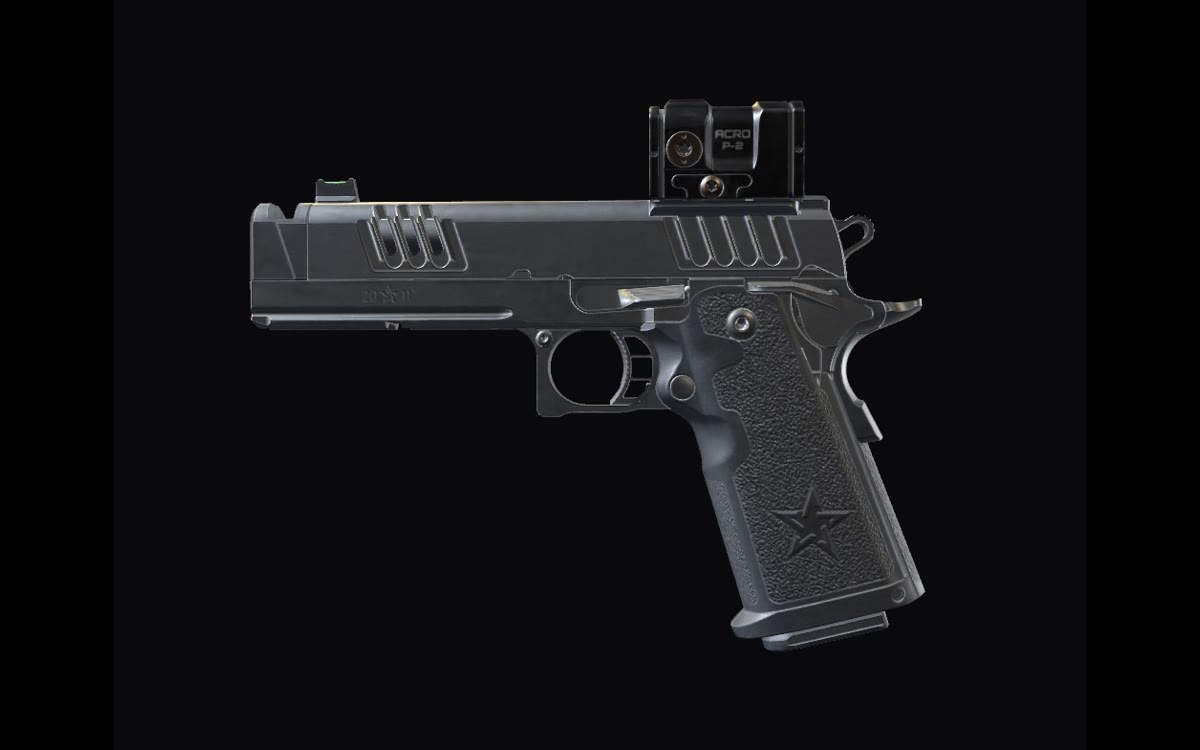
A 2011 costs two to four times what a good striker-fired duty pistol costs, and it is worth understanding why before you decide whether that is a price or a premium. This is a buyer's guide, not a parts ranking: the 2011 aftermarket is small and most of what matters is decided when you choose the gun. It covers what a 2011 actually is, why hand-fit parts cost what they do, the Staccato lineup with verified prices, how optics mount, and the field from Springfield's Prodigy to Atlas Gunworks.
Every model name and price below was checked against the manufacturer's own listing at the time of writing. Where a price could not be verified the model is named without one.
WHAT A 2011 IS
A 2011 is a double-stack 1911. It keeps the 1911's single-action, hammer-fired lockwork — the same trigger, thumb safety, grip safety and slide-stop arrangement John Browning drew — and replaces the single-stack steel frame with a two-piece design: a steel frame that carries the rails and lockwork, and a modular polymer grip that bolts to it and holds a double-stack magazine. The result is a 1911 trigger with 15 to 20 rounds of 9mm and a grip that is narrower than the magazine would suggest, because the polymer does the work the steel used to.
The name is a trademark. STI International coined "2011" for the design it built with Virgil Tripp and Sandy Strayer, and Staccato, the company STI became, holds the registration. The patent expired years ago, so other makers build the same pattern, but they call it a double-stack 1911, a DS, or a model name. When a maker other than Staccato says 2011, it is describing the pattern, not licensing the mark.
FITTING VERSUS DROP-IN
The 1911 pattern predates the tolerances that make a modern striker gun a drop-in platform. On a 2011 the slide is fit to the frame rails, the barrel is fit to the slide and the bushing or the bull-barrel bore, and the trigger group's sear, hammer and disconnector are fit to each other. Fit means a person with a fixture and a stone takes measurable material off until two parts mate the way the design intends. It is the reason a good 2011 has a trigger that breaks like glass and a slide that runs like it is on bearings, and it is the reason the gun costs what it costs.
Drop-in parts exist for the 1911 pattern and some of them are excellent, but on a 2011 the parts that decide accuracy and trigger feel are the fit ones. That has two consequences for a buyer. First, the gun you buy is the gun you will own; you are not buying a chassis to build on. Second, changing those parts later means paying for the fitting again. The parts you can change freely are the grip module, sights, the magazine well, the optic plate and the accessories on the rail. This article does not cover the fitting itself.
WHY THE PRICE
Four things drive the number.
- Machining and fitting labor. A fit slide-to-frame and barrel-to-slide is skilled work measured in hours, not minutes, and it does not scale the way a molded frame and a stamped slide do.
- Volume. Staccato is the largest maker in the category and it builds a fraction of what a major striker-gun maker builds in a month.
- Magazines. A 2011 magazine is a steel tube with a tuned spring and follower that has to feed a 9mm cartridge from a double-stack column into a single-feed chamber, and a bad one stops the gun. The legacy Staccato magazines are proprietary and expensive; the newer HD series feeds from Glock-pattern magazines, which is a large part of its appeal.
- The trigger. A single-action 1911 trigger at a clean weight is the thing you cannot buy in a striker gun at any price. It is what most 2011 buyers are actually paying for.
THE STACCATO LINEUP
Staccato's current line splits into the legacy 2011 models with proprietary magazines and the HD series with Glock-pattern magazines. Prices are Staccato's own listings; the HD guns are sold in Core, Preferred and Premium packages, and the price differences between them are the package contents.
- Staccato C2: $2,299.00. A 3.9-inch bull barrel and 16+1 capacity; the entry point to the line and the compact most owners start with.
- Staccato P: $2,499.00. The 4.4-inch bull-barrel duty gun, 17+1 or 20+1, and the model that put the 2011 in police holsters.
- Staccato C: From $2,599.00. A 4.0-inch bull barrel with 15+1 or 17+1 depending on grip size.
- Staccato CS: $2,699.00. The 3.5-inch, 15+1 carry gun on a slimmer 9mm-specific magazine.
- Staccato XL: $3,599.00. A 5.4-inch bull barrel, 17+1 or 20+1, the long-slide for competition and precision.
- Staccato XC: $4,299.00. A 5.0-inch Island Comp one-piece barrel with an integrated compensator, 17+1 or 20+1, the top of the legacy line.
- Staccato HD C3.6: $2,299.00 Core, $2,499.00 Preferred, $2,799.00 Premium. A 3.6-inch bull barrel, 15+1, compatible with most Glock 19-size magazines.
- Staccato HD P4: $2,499.00 Core, $2,699.00 Preferred, $2,999.00 Premium. A 4.0-inch bull barrel, 18+1, on Glock 17-pattern steel magazines.
- Staccato HD C4X: $3,499.00 Core, $3,699.00 Preferred, $3,899.00 Premium. A 4.0-inch one-piece barrel with an integral compensator, 15+1, Glock 19-size magazines.
- Staccato HD P4X: $3,599.00 Core, $3,799.00 Preferred, $3,999.00 Premium. The same integral-comp barrel at 18+1 on Glock 17-pattern magazines.
The HD line is the practical answer for most buyers in 2026: it costs what the legacy compacts cost, it feeds from magazines you can buy anywhere, and Staccato mounts and zeroes the optic for you when you buy an optic-ready gun with an optic on its own site.
OPTIC MOUNTING: DPO AND HOST
Legacy Staccatos use the Dawson Precision Optic system, DPO: a milled recess in the slide that takes an optic-specific plate carrying its own rear sight. Dawson lists the plates directly — the Aimpoint ACRO plate at $129.95, the Trijicon RMR and RMR HD/SRO plates at $129.95, and the Leupold DeltaPoint Pro plate at $49.95 — and Staccato includes optic-specific plates with the XC and cover plates with the XL. The plate is one more interface than a direct cut, but it means a Staccato takes almost any footprint on the market by changing a plate, and the ACRO P-2 at $617.00 from Aimpoint is the enclosed-emitter choice most duty buyers put on it.
The HD series replaces DPO with what Staccato calls the HOST mounting system: Staccato describes it as attaching the optic directly to the slide with spacer plates, which removes the DPO plate from the stack. It is another reason the HD guns are the better buy for a first 2011.
LIGHTS
A 2011's rail is a standard 1913 pattern on the full-size models, so the duty lights fit. Staccato itself lists the Streamlight TLR-7 sub and the SureFire XSC-B as the lights for the CS. On the full-size guns, SureFire's XVL2 at $1,799.00 — 400 lumens with co-aligned green and infrared lasers, 3.0 inches and 5.0 ounces — is the duty and night-vision option; it is heavy for what a 2011 already weighs, and it is a job-specific purchase.
THE FIELD
Staccato is the reference, not the only choice, and the alternatives bracket it on price in both directions.
- Springfield Armory 1911 DS Prodigy: Springfield's own listings put the 4.25-inch AOS and the 5-inch AOS at $1,530 MSRP, the 3.5-inch Compact AOS at $1,582, and the Prodigy Comp with an integrated compensator at $1,632. Each ships with a 17-round and a 20-round magazine and uses Springfield's Agency Optic System plates. The Prodigy is the gun that made the double-stack 1911 a mid-price category, and the trade-off against a Staccato is in the fitting and the magazine tuning, not the feature list.
- Atlas Gunworks: The other end. Atlas's current V2 line lists the Hyperion V2 at $5,300.00, the Nyx V2 at $5,300.00 and $5,700.00 optics-ready, the Athena V2 at $5,700.00, the Nemesis V2 at $5,900.00, the Ares at $6,000.00, the Artemis V2 at $6,400.00 and the Erebus V2 at $6,500.00. These are hand-fit competition guns from a small shop, and the price is the labor described above with nothing amortized across volume.
- Bul Armory SAS II: The Israeli maker's double-stack 1911 line, sold in TAC and Ultralight versions among others, and the usual answer to "a 2011-pattern gun for less than a Staccato." Bul's US pricing could not be verified against the manufacturer at the time of writing, so confirm current MSRPs with a dealer.
Other makers have entered the category since 2024 and more will. The questions to ask any of them are the ones above: who fits the slide and barrel, what magazine does it feed from, and how does the optic mount.
WHAT YOU ARE PAYING FOR
Put the pieces together and the price is legible. A Prodigy at $1,530 buys the pattern, the capacity, an optic plate system and a real 1911 trigger, with less hand-fitting. A Staccato HD at $2,299 to $2,999 buys the fitting, the magazines that work everywhere, HOST optic mounting and a warranty from the company that owns the name. A legacy Staccato at $2,499 to $4,299 buys the same fitting on the proprietary magazine and, at the top, an integrated compensator. An Atlas at $5,300 and up buys a shop's full attention to one gun. None of those is a bad deal for what it is; the mistake is paying for fitting you do not need or skipping fitting you do.
Magazine capacity and compensated barrels are regulated differently in some states; verify your state law before ordering any of these.
ON THE BENCH
Gear Guy lets you configure a Staccato 2011 in 3D from real named parts. Seat the Aimpoint ACRO P-2 on the DPO plate, put a SureFire XVL2 on the rail and see the full-size 2011 on screen before you decide what a $2,500 pistol should carry. The compatibility engine reads the same catalog and warns when an optic's footprint does not match the slide or when a light does not fit the rail.
Once the gun is real, the Armory stores it in an AES-256-GCM encrypted vault on your device with no account and the serial masked by default. The range log tracks round counts and deducts ammunition, which matters on a gun whose magazines want tracking; the Capability sheet shows white light and suppression for the build; the PDF insurance and estate report on Premium documents a pistol that is worth insuring; Identify can stand the gun up on the bench from a photo; and a build can be shared as a link at gearguyapp.com/b/.
FINAL THOUGHTS
Buy the 2011 for the trigger, and buy the one whose magazines you can live with. For a first 2011 in 2026 that means a Staccato HD P4 or C3.6, or a Prodigy if the budget stops at $1,600 and you accept the fitting difference. Put an ACRO on it if it is a duty gun and an RMR if it is not. Leave the fit parts alone, change the grip and sights freely, and track the magazines. The price is the labor; make sure you are buying the labor you will use.