A firearm's round count is the one fact about it that nobody can reconstruct later. The serial number is on the receiver. The parts are visible. The purchase price is on a receipt somewhere. The rounds are gone, and if you did not write them down as they happened, the honest answer to "how many rounds through it" is a guess. Every decision that depends on that number, when to change a barrel, when to swap springs, what to tell a buyer, inherits the guess.
This article covers what a round count actually predicts, with the published figures and the definitions behind them, and then how Gear Guy's range log captures the count per firearm and keeps it honest.
WHAT A ROUND COUNT PREDICTS
Three things. When the barrel will stop shooting to your standard. When the wear parts are due. And whether the maintenance record you hand a buyer is credible. Each rests on figures that circulate widely, and each figure is only useful with its definition attached, because "barrel life" in particular means very different things to different people.
BARREL LIFE, BY CARTRIDGE, WITH THE DEFINITION
5.56 AND .223
The most-cited civilian figure comes from a Primary Arms guide (July 2024): "an AR-15 chambered in .223 Remington and 5.56 NATO can expect to fire 10,000 to 20,000 rounds before needing a barrel replacement." Its definition of "needing" is practical: groups open up, or bullets begin keyholing because the worn bore no longer stabilizes them. The guide cites no test for the number, so treat it as a retailer's rule of thumb, not a measurement.
The New Rifleman's barrel guide reports a different standard: ADCO Firearms "runs a stainless steel barrel to 15k rounds and finds that it is still capable of minute-of-man accuracy." Minute-of-man is a far looser bar than a precision shooter's. Same class of barrel, and the "life" figure moves with the standard you apply.
.308 AND 6.5 CREEDMOOR
Precision cartridges wear faster and the figures are tighter. Eagle Eye Precision Ammunition's comparison states that with 6.5 Creedmoor "shooters generally do not see much in excess 2,500-3,000 rounds," while for .308 Winchester "it is not uncommon for barrels to last in excess of 5,000+ rounds." Tactical Skeleton (2022) gives a "typical 6.5 Creedmoor barrel life of 2,000-3,000 rounds." Both define the end of life by throat erosion: the same powder charge burning into a smaller bore erodes the throat faster. These are precision-shooter figures, where "done" means sub-MOA is gone, not that the rifle no longer hits a plate.
WHY THE DEFINITION IS THE WHOLE ARGUMENT
PrecisionRifleBlog put it plainly in 2020: "The whole concept of 'accurate barrel life' is subjective and varies person-to-person." What can be measured is erosion. The author tracked his own 6mm Creedmoor barrel's throat moving 0.006 to 0.007 inches per 100 rounds over 1,300 rounds, and cites a 6.5-284 at 0.0037 inches per 100. Which symptom shows first, velocity falling or groups opening, "seems to depend on the cartridge you're shooting and how many rounds you usually fire before allowing the barrel to cool."
So the round count is the input and your standard is the threshold. Two thousand rounds of slow fire and two thousand rounds of rapid strings are not the same two thousand, and a hunting rifle held to a loose standard has a longer life than a match rifle held to a tight one. None of that can be reasoned about without the count.
WEAR PARTS AND THEIR INTERVALS
Here the honest picture is uneven. For AR-15 bolt parts, manufacturers publish few hard round-count intervals; what circulates are rules of thumb and functional checks, and they should be labeled as such. Pistol recoil springs are different: some manufacturers do state a service life in rounds.
GAS RINGS AND EXTRACTOR SPRINGS
Gun Digest's bolt-maintenance piece offers a rule of thumb of new gas rings "every 5,000 rounds," and the check that matters more than the number: hold the bolt carrier group in the air by the bolt and see whether the carrier slides down under its own weight. If the rings hold it, they are still sealing. The author notes his own rifle at 12,000 rounds passed the test and got new rings anyway.
The Prepared published a preventive schedule in 2020, written by a staff writer rather than a manufacturer: "At 5,000 rounds, replace the extractor, extractor spring, ejector, ejector spring, and gas rings." "At 10,000 rounds, replace the bolt carrier group, and buffer spring." The same piece concedes that "AR-15's have been documented to run for 10,000 rounds + with no maintenance." That is the right way to read every interval in this section: a point at which replacing a cheap part is reasonable, not a point at which the rifle stops.
PISTOL RECOIL SPRINGS
Wilson Combat's product page for its 5-inch 1911 16-pound recoil spring states: "With an average service life of 3,000 rounds, this quality component should be replaced accordingly for optimal performance." That is a manufacturer's number with an interval in rounds. For Glock pistols, Primary Arms reported in September 2025 that "GLOCK recommends replacing recoil spring assemblies approximately every 3,000 to 5,000 rounds, though this interval may vary depending on the caliber and intensity of use." That is secondhand; the armorer's manual for your generation is the source to check.
The common thread is that every interval is denominated in rounds. Without a count, none of them can be applied. You either replace parts on a calendar, which wastes money on a safe queen and starves a range gun, or you replace them when they fail, which is the expensive way to learn the interval.
HOW THE RANGE LOG CAPTURES IT
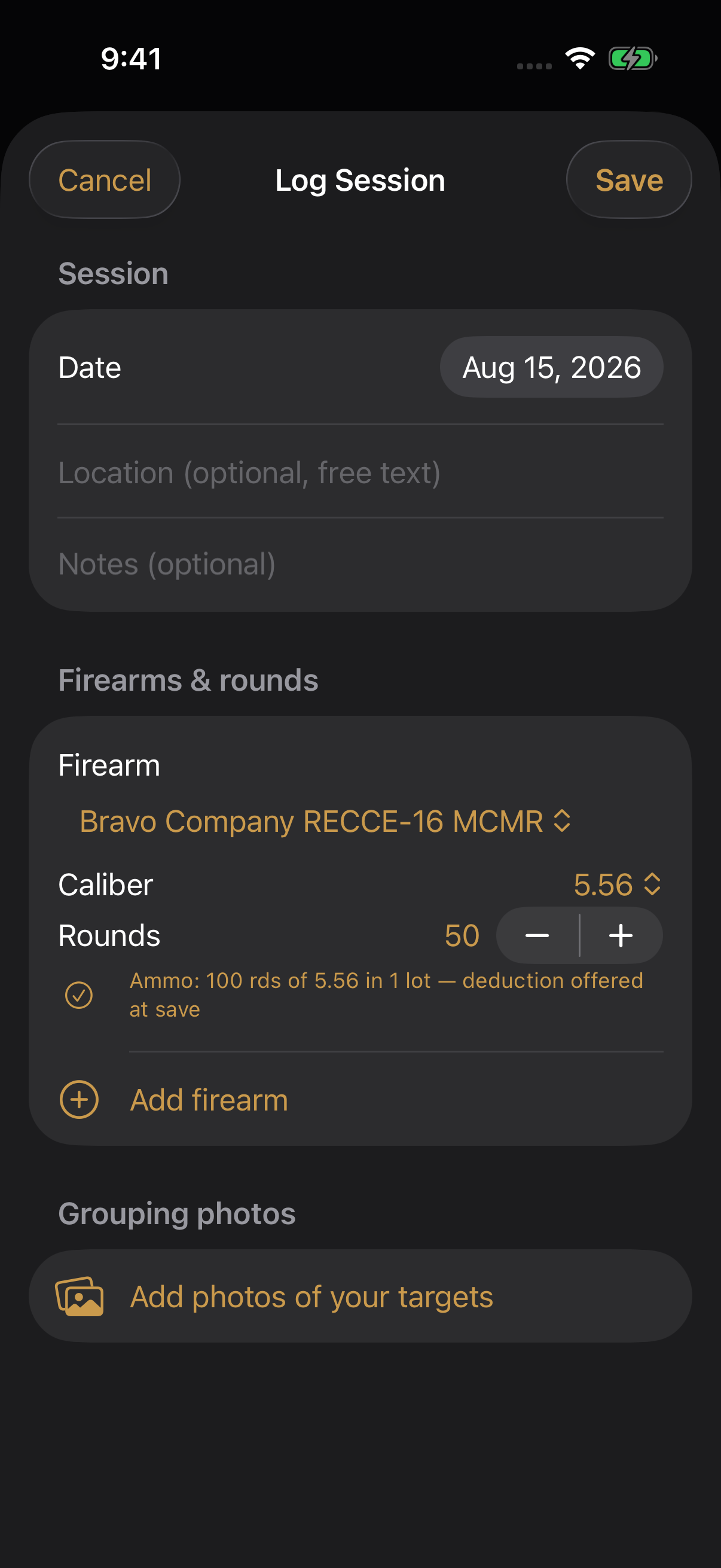
Gear Guy's range log is built around the session, because that is how shooting actually happens. A session has a date, a location you type in (free text; the app never reads your device's location), notes, and one row per firearm and caliber with the rounds fired. You can attach target photos; they are stored encrypted in the same vault as everything else.
LIFETIME ROUNDS, PER FIREARM
Each firearm record carries a "Lifetime rounds" figure with two parts. "Before logging" is your own approximate count from before you started tracking, entered once and editable any time. On top of it, every logged session that names the firearm adds its rounds. The total is derived from the sessions each time it is shown, never stored as a separate number, so it cannot drift from the record that produced it. If you delete a firearm, its sessions keep their entries; the rounds were fired, and history is history.
AMMUNITION DEDUCTION
If you keep an ammunition ledger in the Armory, saving a session prompts you to deduct. The app groups the session's rounds by caliber, matches them to the lots you own (it normalizes "5.56," "5.56x45" and "5.56 NATO" to one caliber, so three ways of writing the same thing do not produce three lots), pre-selects the lot when there is only one and the largest when there are several, and shows any shortfall instead of silently clamping it. You confirm, change the lot, or skip.
The deduction is recorded on the session. Delete the session later and the app offers to put back exactly what it took, not a recomputation from the entries. Edit a session and the ammunition is left alone; the editor tells you so: "Edits don't re-deduct — adjust the lot in Ammo if what you shot changed." Round counts and ammunition are two ledgers that agree because one writes to the other once, on purpose, with your confirmation.
WHAT IT DELIBERATELY IS NOT
The log is a record of what you did. There are no timers, no drills, no scoring and no coaching. It does not compute ballistics. It has no account, no cloud copy and nothing transmitted; the sessions live in the AES-256-GCM encrypted vault on your device, and no share or export surface reads them by default. The insurance PDF the Armory can generate lists ammunition on hand by caliber, not rounds fired per firearm; the range log stays in the app.
WHAT A DOCUMENTED HISTORY IS WORTH
The resale market is candid about round counts. Dirty Bird Industries' guide to buying used tells buyers to "ask for a specific round count estimate, as vague answers like 'lightly used' are red flags," and that "high round counts can still be a deal if priced right and maintenance is documented, such as replaced springs or regular cleaning." Its summary: "A well-maintained high-round gun often beats a neglected low-round one."
The other side of the ledger is worth stating too. 2A Marketplace's valuation guide notes that "for standard used guns, undocumented history generally doesn't affect price," but "evidence that a gun was poorly maintained, dropped, or modified can reduce value below its apparent condition grade," while "provenance (documented ownership history) can significantly increase value for collectible firearms." The same guide puts the original box, manual and spare magazines at "a 10–20% premium."
Read together, the value of a log is asymmetric. On a common rifle it rarely adds a premium; what it does is remove the discount that "lightly used" invites, and let you state a number and a maintenance date instead. On anything collectible, the documented history is the provenance. And before any sale, it is the difference between replacing a spring kit on schedule and finding out at the range that the interval had passed.
FINAL THOUGHTS
Every maintenance interval, every barrel-life figure and every buyer's first question is denominated in rounds. The figures are only as good as their definitions, and your count is only as good as the day you started keeping it. Start at whatever number you can honestly estimate, log each session as one entry per firearm, let the ammunition ledger follow, and the history writes itself. The rifle will not remember. The log will.