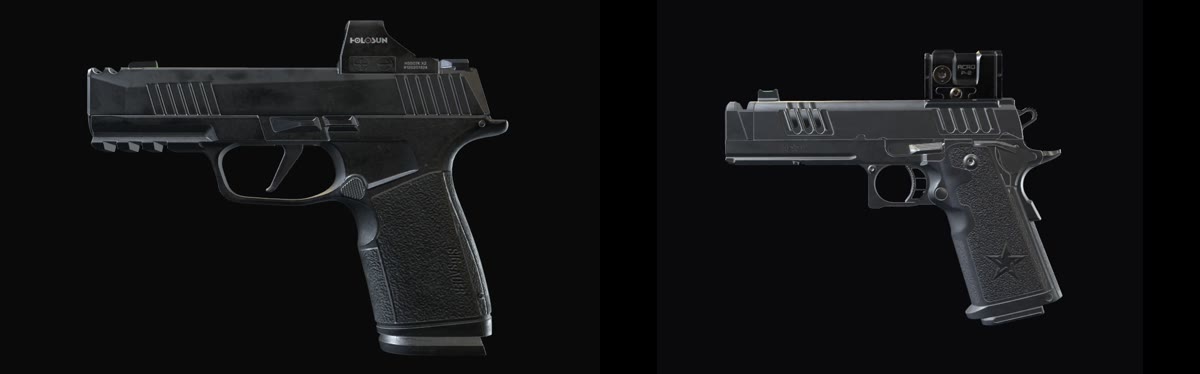
Four optics define the pistol red dot market in 2026, and each one gave its name to a mounting pattern. The Trijicon RMR is the duty standard and the footprint every plate system supports. The Holosun 507K is the micro dot that made slimline carry guns optic-ready. The Aimpoint ACRO P-2 is the enclosed emitter that duty users moved to when weather and holster lint became the failure mode. The Trijicon RMRcc is Trijicon's answer for slim slides that could not take a full RMR.
This guide compares the four on the things that decide a purchase: the footprint and what mounts it, open versus enclosed emitter, window size, battery, how high the optic sits, and price. Every specification below comes from the manufacturer's own listing, and every price was verified against the manufacturer or a major dealer at the time of writing.
FOOTPRINTS FIRST
A footprint is the pattern of screw holes and recoil bosses machined into a slide or a plate. An optic mounts only to its own footprint, so the slide cut or the adapter plate decides the optic before anything else does.
- RMR footprint: The most widely supported pattern. Direct-milled cuts, the Glock MOS plate system, the M&P C.O.R.E. plates and Staccato's DPO plates all offer it. The Holosun 507C and many others share it.
- K footprint: Holosun's slimline pattern, derived from the Shield RMSc. It uses the RMSc screw spacing with two shorter front bosses and no rear boss pockets. It mounts directly on cuts that accept it, such as the SIG P365-XMACRO, and it needs a plate or a slide modification on cuts built to the strict RMSc spec, such as the Glock 43X MOS.
- ACRO footprint: Aimpoint's own interface. It is supported by dedicated plates rather than by direct cuts on most factory slides.
- RMRcc footprint: Trijicon's narrow pattern. It is not the RMR footprint, and it needs its own cut or plate.
TRIJICON RMR TYPE 2
The RMR Type 2 is the optic the others are measured against. Sport Optics lists the RM06, the 3.25 MOA adjustable-LED version, at $742 with a sale price under $500, and Trijicon's own MSRP sits slightly above that. It weighs 1.2 ounces, runs a CR2032 rated for four years at brightness setting four, and its objective window measures 22 by 16 mm, about 0.87 by 0.63 inches, in a body 1.8 by 1.1 by 1.0 inches. The battery loads from underneath, so a battery change means pulling the optic and re-zeroing, which is the RMR's one design complaint. It is an open emitter with a forged aluminum housing, and it is the footprint every plate system supports.
Where it mounts: any RMR-cut slide, the Glock MOS plate 02 ($13.19 from Glock) or the C&H V4 plate ($79.99), the M&P M2.0 C.O.R.E. via C&H's RMR plate ($51.99), and Staccato's DPO system via Dawson's RMR plate ($129.95).
HOLOSUN 507K X2
The 507K X2 is the reason slimline carry guns ship optic-ready. Holosun lists it at $348.22 and it commonly sells around $300. It weighs 1 ounce, measures 1.6 by 0.98 by 0.95 inches, and its window is 0.58 by 0.77 inches. The battery is a side-loading CR1632 rated for 50,000 hours, so the optic stays on the slide for a battery change. The reticle is Holosun's multi-reticle system, a 2 MOA dot with a 32 MOA circle you can run together or separately, with Shake Awake and a solar backup. It is an open emitter.
Where it mounts: directly on the SIG P365-XMACRO's RMSc-pattern cut; on the Glock 43X MOS and 48 MOS only with an adapter plate, which adds roughly 3 to 4 mm of height, or a modified slide, because the factory cut's rear bosses interfere with the K body; and on full-size Glock MOS through a K-pattern plate such as the Calculated Kinetics DOGTAG ($64.99).
AIMPOINT ACRO P-2
The ACRO P-2 is the enclosed emitter that duty users chose once open-emitter failures in rain and holster debris became a documented problem. Aimpoint lists it at $617.00. It weighs 2.2 ounces, measures 47 by 33 by 31 mm, about 1.9 by 1.3 by 1.2 inches, and its clear aperture is 15 by 15 mm, about 0.59 by 0.59 inches. The CR2032 is rated for 50,000 hours at setting six, the housing is 7075-T6 aluminum, it is submersible to 35 meters, and it carries ten brightness settings, four of them night-vision compatible. The dot is 3.5 MOA in the version most often sold for pistols, with a 2.5 MOA version available.
Where it mounts: on Aimpoint's own Glock MOS ACRO Mount Plate ($66.00) or the DOGTAG ACRO version ($64.99) on full-size MOS slides; on the M&P M2.0 C.O.R.E. via C&H's ACRO plate; and on Staccato's DPO system via Dawson's ACRO plate ($129.95). Aimpoint's Glock plate does not fit the slimline models.
TRIJICON RMRCC
The RMRcc is the RMR shrunk to fit a slim slide. Sport Optics lists the CC06, the 3.25 MOA version, at $699 with a sale price under $500. It weighs 1.0 ounce, is 1.8 inches long, and runs a CR2032 rated for four years. Trijicon's spec sheet gives the window as 0.76 by 0.56 inches, narrower than the RMR's, in a body about 0.9 inches wide. Like the RMR it is an open emitter with a bottom-loading battery, and it uses its own narrow footprint rather than the RMR's.
Where it mounts: on slides cut for the RMRcc pattern, on the Glock 43X MOS and 48 MOS through a C&H adapter plate, on full-size Glock MOS through C&H's RMRcc plate, and on the M&P M2.0 C.O.R.E. through an adapter plate.
SIDE BY SIDE
| RMR Type 2 | 507K X2 | ACRO P-2 | RMRcc | |
|---|---|---|---|---|
| Footprint | RMR | K (RMSc-derived) | ACRO | RMRcc |
| Emitter | Open | Open | Enclosed | Open |
| Window | 0.87 x 0.63 in | 0.58 x 0.77 in | 0.59 x 0.59 in | 0.76 x 0.56 in |
| Weight | 1.2 oz | 1.0 oz | 2.2 oz | 1.0 oz |
| Battery | CR2032, bottom | CR1632, side | CR2032, side | CR2032, bottom |
| Rated life | 4 yr at setting 4 | 50,000 hr | 50,000 hr at setting 6 | 4 yr |
| List price | $742 | $348.22 | $617.00 | $699 |
Window dimensions are as each manufacturer lists them; the RMR and RMRcc figures are the objective size and the ACRO figure is the clear aperture. Battery ratings are the manufacturer's stated figures at the stated setting and are not comparable across brands.
OPEN VERSUS ENCLOSED
An open emitter projects the dot from an LED behind the window across open air. Anything that lands on the emitter — rain, snow, holster lint, a thumb — blocks the dot. An enclosed emitter puts a second lens in front of the LED, so the optical path is sealed. That is the entire argument for the ACRO P-2, and it is why it weighs twice what the 507K does and costs nearly twice as much. If the gun rides in a duty holster in weather, the enclosed emitter is the answer. If it rides in an appendix holster under a shirt, an open emitter with a habit of wiping the window is what most carriers run.
WINDOW SIZE
Window size is about finding the dot on the draw, not about precision. The RMR's 22 by 16 mm window is the largest here and the easiest to pick up. The ACRO's 15 by 15 mm aperture reads smaller than the numbers suggest because the housing walls are thick; owners describe it as looking through a tube. The 507K and RMRcc are the slim options and give up window for slide width. A larger window forgives a worse presentation; a smaller one demands a consistent draw.
BATTERY AND ACCESS
Where the battery loads decides how painful maintenance is. The 507K and ACRO load from the side, so the optic stays mounted and zeroed. The RMR and RMRcc load from the bottom, so a battery change means removing the optic; Trijicon's four-year rating is the compensation. Holosun's 50,000-hour figure and Aimpoint's 50,000-hour figure are rated at specific brightness settings, and running brighter shortens both.
HEIGHT OVER BORE
How high the dot sits above the slide affects co-witness with iron sights and how far you have to shift from an iron-sight presentation. Three things add up: the optic's own deck height, the depth of the cut, and any plate between them. A direct-milled cut sits lowest. Every plate adds its own thickness on top, and on the slimline Glock MOS the K-footprint plate adds roughly 3 to 4 mm, which is why owners have slides modified instead. Overall optic heights from the manufacturers run from the RMRcc at about 0.9 inches to the ACRO at 1.2 inches, but overall height is the housing, not the dot; the number that matters is where the dot sits over the specific slide and plate you own, and no spec sheet gives that.
WHICH SLIDES TAKE WHICH
- SIG P365-XMACRO: RMSc-pattern cut, direct mount. Takes the 507K X2 and other RMSc and K-pattern optics directly; the RMR, ACRO and RMRcc are not this cut's footprint.
- Glock 43X MOS and 48 MOS: RMSc-pattern cut. Takes true-spec RMSc optics directly; the 507K needs a plate or a modified slide; the RMRcc and the RMR mount through C&H plates, the RMR overhanging the slim slide; no ACRO.
- Glock 17, 19, 34, 45 MOS: Plate system. RMR through the Glock 02 plate or C&H V4; ACRO through the Aimpoint plate or DOGTAG; 507K through a K-pattern DOGTAG; RMRcc through C&H's RMRcc plate.
- Smith & Wesson M&P M2.0 C.O.R.E.: Plate system. RMR, ACRO and DeltaPoint Pro each through their own C&H plate; RMRcc through an adapter plate.
- Staccato 2011 (DPO): Plate system. RMR and ACRO each through Dawson's DPO plate. The newer Staccato HD uses its own HOST spacer-plate system.
PRICE
At list, the 507K X2 is the least expensive at $348.22 and the RMR the most at $742, with the ACRO at $617.00 and the RMRcc at $699 between them. On the street the two Trijicons sell for far less than list, so the real spread is narrower than the MSRPs suggest. Add the plate where one is needed: $13.19 to $79.99 on a Glock MOS, $51.99 on an M&P, $129.95 on a Staccato.
ON THE BENCH
Gear Guy lets you configure a pistol in 3D from real named parts, and it treats optics the way slides do: by footprint. Seat a 507K on the P365-XMACRO, an RMRcc on the M&P M2.0, an RMR or ACRO on a Glock MOS plate, or an ACRO on a Staccato's DPO plate, and see the build. The compatibility engine warns when an optic's footprint does not match the slide cut, when a plate-system slide has an optic equipped without its plate, and when a full-size optic is asked to fit a slimline cut — and it names the plate or slide that fixes it.
Once the optic is on a real gun, the Armory keeps it in an AES-256-GCM encrypted vault on your device with no account, the range log tracks round counts against the configuration you shot, and a build can be shared as a link at gearguyapp.com/b/.
FINAL THOUGHTS
Pick the footprint your slide takes, then pick the optic. On a full-size duty gun in weather, the ACRO P-2. On a full-size gun that lives in a holster under a shirt, the RMR or its Holosun equivalent. On a slimline carry gun, the 507K X2 where it mounts directly, and the RMRcc where a Trijicon is the requirement. The four optics are all good; the mistake people make is buying the dot before they know the cut.