Our earlier piece on why a digital gear vault matters described the failure mode: a fire or a burglary, a claim, and no documentation. This article is the next layer down. What does a homeowners policy actually pay for firearms, what does scheduling them change, what will the adjuster ask you to produce, and how do you have it ready without keeping a paper list of your guns in the house?
Two caveats up front. This is general information about how the process typically works, not insurance advice and not legal advice; policy language differs by carrier and by state, so confirm every point below with your own carrier and verify your state law. And no valuation in an app is an appraisal, including Gear Guy's.
THE SUB-LIMIT MOST OWNERS DO NOT KNOW ABOUT
A homeowners policy covers personal property up to a limit, but certain categories carry their own, much lower caps. Firearms are one of them, and the figures published by insurers and industry sources vary:
- Policygenius (2023): "Firearms typically have a collective sublimit of $2,500" for theft.
- Leavitt Group (updated 2023): "almost all insurance companies put a sub-limit—usually between $2,000 and $3,000—on losses for guns that are stolen from a home, destroyed in a fire, or lost in some other catastrophic event."
- American Family (2019): "A standard coverage limit for theft of firearms on a homeowners insurance policy is about $5,000."
- Grit Insurance: "Standard homeowners policies cap firearm coverage at $2,500 to $5,000 total."
- Liberty Mutual lists firearms among items that "can have different limits."
Two words in those sentences carry the weight. "Collective" and "total" mean the cap applies to the whole collection, not per gun. And most of the sources describe theft; whether the same cap applies to fire depends on the policy form, which is why Leavitt's wording is worth reading twice. Do the arithmetic against your safe. One rifle, one optic and one suppressor can pass $2,500 on their own, and the rest of the collection is then uninsured against theft unless you have done something about it.
SCHEDULED PERSONAL PROPERTY
The something is a scheduled personal property endorsement, often called a rider. It lists specific items individually, at a value you and the carrier agree on, and those items are then covered to that value rather than under the category cap. Leavitt describes the preparation in four steps: make a list "including make, model, and serial number" with photographs, "appraise or otherwise arrive at a value for each item," include accessories "such as scopes, rings, magazines, and after-market grips," and take it to your agent. Its description of a claim under a schedule is that the insurer "will pay the appraised value of the gun up front. Then, when you replace it, you can submit receipts and your insurer will reimburse you for any difference." That is one agency's description of one arrangement; yours may differ. The point that does not vary is that the documentation is demanded before the loss, at scheduling time, not after.
WHAT A CLAIM ACTUALLY NEEDS
PROOF OF OWNERSHIP AND PROOF OF LOSS
Allstate's explainer (updated May 2026) separates the two documents an adjuster works from. Proof of ownership is "documentation that proves an item belonged to you before it was damaged or stolen," and "can be bank statements, receipts, online registration or photos." Proof of loss "is a legal document that explains what's been damaged or stolen and how much money you're claiming." Its advice on the inventory behind both: it "should list item value, purchase date, receipts, serial numbers or make/model, and can be enhanced with photos or video."
The Insurance Information Institute says the same in industry terms: "describe each item you record, and note where you bought it, the make and model, what you paid," and for valuable items keep "sales receipts, purchase contracts, and appraisals." Progressive (2024) adds that some insurers may request "proof-of-purchase receipts, serial numbers and/or photos." Notice that none of this is specific to firearms. An adjuster handling a gun claim is running the same process as for a camera or a watch; the difference is that for a firearm the serial number is not optional.
SERIAL NUMBERS AND PHOTOGRAPHS
Grit Insurance's collector guidance is the firearms-specific version: "Record serial numbers, make, model, caliber, and any modifications." "Photograph every firearm." "Keep receipts, provenance records, and appraisal documents." The serial number identifies the item in a police report and on the claim; a photograph of the firearm, and of the serial, ties the record to the object. Modifications matter because a rifle wearing an optic and an aftermarket trigger is not the rifle on the original receipt.
APPRAISALS FOR HIGH-VALUE PIECES
Your own value estimate is what a home inventory records, and for common items it is what the adjuster will work from. It is not an appraisal. Grit advises that high-value pieces be "appraised by someone who knows the market," and American Family's inventory guide asks for "appraisals at time of purchase. Especially if your items were appraised for insurance purposes." If a piece is being scheduled at a value that would matter to you, expect to be asked how that value was arrived at.
KEEP THE RECORDS OUTSIDE THE HOUSE
Every source agrees on this, and firearms owners have a particular reason to listen. Grit: "Store copies outside the home - a fireproof safe does not help if the adjuster needs records you cannot produce." American Family: "Storing a copy of your home inventory list outside of your home is recommended. Otherwise, it turns into a treasure map should your home be burglarized." The Insurance Information Institute suggests "a safe deposit box or at a friend's or relative's home," and the California Department of Insurance "a safe-deposit box, work office, or a relative's house."
The treasure-map line is the tension in one sentence. A complete list of your firearms with serials and values is exactly what you need after a loss and exactly what you least want found before one. A paper list in a drawer fails both ways. An encrypted record, with a copy you control somewhere else, is the only form that satisfies both.
NFA ITEMS AND TRUST DOCUMENTS
Suppressors, short-barreled rifles and other NFA items add a federal document to the packet. The statute is explicit: under 26 U.S.C. § 5841(e), "A person possessing a firearm registered as required by this section shall retain proof of registration which shall be made available to the Secretary upon request." The approved Form 4 or Form 1 is that proof, and it is also the ownership document for the item. As of January 1, 2026 the federal tax is $0, but registration is still required.
If your items are held in a trust, the trust is the registrant, and an insurer needs to know that. Grit's guidance: "If your collection includes NFA items held individually or in a trust, your policy needs to reflect that structure," and "Approved Form 4s, tax stamps, and trust documents should be on file with your agent." Gun & Trophy Insurance's overview is blunter: "If your collection includes class III weapons or NFA firearm or firearm accessory as regulated by the ATF then it is best to check with your insurance company to see if they cover these items." It also notes that some policies reimburse "expenses that you make to a governmental authority for tax stamps," which matters less at a $0 tax but says something about how replacement is treated. Replacing an NFA item is not a trip to the store; it is a new transfer and its wait. Verify your state law for anything beyond the federal layer.
HOW THE ARMORY AND THE PDF REPORT PRODUCE THE PACKET
THE ARMORY
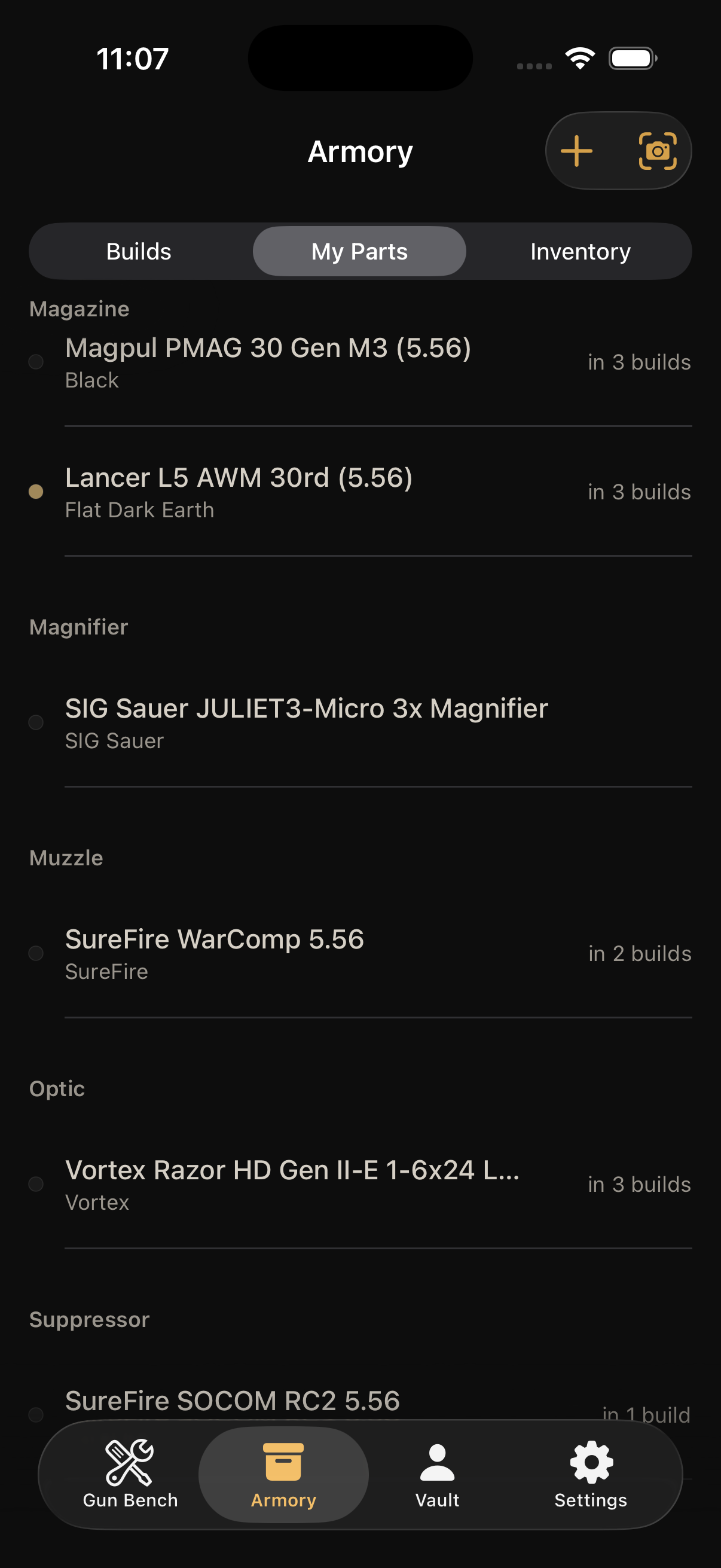
Gear Guy's Armory holds each firearm as a record: name, caliber, serial number, photo, and your own estimated value. Serial numbers are masked on every roster surface by default; the app shows asterisks with the last four characters. Parts you own sit in a parts ledger with their cost, so a rifle's optic and trigger are recorded as the items they are rather than folded into a guess about the rifle. Ammunition lots and other gear have their own ledgers.
All of it is stored in an AES-256-GCM encrypted vault on the device. There is no account, no cloud copy and nothing transmitted. An opt-in recovery code lets you restore access to the vault if you ever need to.
THE INVENTORY REPORT
Premium members can generate the packet as a document. The report describes itself as "a professionally formatted PDF of your firearms, parts, ammunition, and gear — for insurance documentation or estate planning." It has up to five sections, and empty ones are omitted. Firearms, one per record, with a photo thumbnail, name, caliber, the serial number if you chose to include it, and value. Parts, with quantity and estimated value, drawn from the parts ledger. Ammunition by caliber, with rounds on hand. Gear. And a Summary with counts and the estimated total.
Three of its choices exist because of the process above. The cover states, in print, "All values are owner-estimated and self-reported — not a professional appraisal," so an adjuster reads your numbers as your numbers. Serial numbers are an explicit toggle, "Include serial numbers," off by default, with the note "For insurance documentation. Off by default — serial numbers are masked everywhere else in the app." And any part the app could only place by category prints as "identified by category only" with no value, and the summary says how many, so the line items never sum past the printed total. The report also states which ammunition valuation basis it used, because that choice alone can move the total by thousands.
GENERATED ON THE DEVICE
The PDF is rendered in memory on your phone. Firearm photos are decrypted for the render and never written out unencrypted; the finished file is handed to the system share sheet from a temporary location the operating system manages, and the app keeps only a note that a report was generated, when, and with which toggles, never the document itself. Where the copy goes is your decision. Send it to a device you trust, or a location you control, and you have satisfied the outside-the-house rule without a paper list anywhere.
WHAT THE REPORT IS NOT
It is not an appraisal, and it says so on its cover. It is not proof of purchase; keep the receipts. It does not replace scheduling; it is what you bring to the agent when you schedule. And Gear Guy has no connection to any insurer. It does not file claims, it does not transmit your inventory anywhere, and it does not know what your policy says. Confirm the coverage with your own carrier.
FINAL THOUGHTS
The policy caps are low, they are collective, and the way around them is documentation delivered before the loss. What the adjuster asks for is unglamorous: serials, purchase records, photographs, a value you can defend, an appraisal where the value is large, and for NFA items the federal paperwork you are required to keep anyway. Keep it encrypted, keep a copy somewhere else, and keep it current. None of this is insurance advice; it is the list of things you will be asked for, so that when you are asked, you have them.