Ask how far an AR-15 can shoot and you will hear numbers from 200 to 800 meters, each stated with the same confidence. Most are not wrong; they answer different questions. A range figure means nothing until two things are attached to it: what it measures, and who published it. This article walks through the figures behind Gear Guy's engagement-class estimate, in the order the app applies them, with the definition and the source beside each one.
WHAT "MAXIMUM EFFECTIVE RANGE" MEANS
The Army's rifle marksmanship manual defined the term. FM 3-22.9, Rifle Marksmanship M16-/M4-Series Weapons (2008), glosses maximum effective range as "the greatest distance at which a soldier may be expected to deliver a target hit." That is a hit-probability definition. It says nothing about wound ballistics, fragmentation, or energy on target: only whether a trained soldier with the issued weapon and sights can be expected to hit.
The manual splits the figure in two: a point target is a single target, roughly one person; an area target is a group or position where a hit anywhere in it counts. Table 2-1 gives both, with the muzzle velocity each assumes:
| Weapon | Barrel | Point target | Area target | Muzzle velocity |
|---|---|---|---|---|
| M16A2 rifle | 20 in | 550 m | 800 m | 3,100 ft/s |
| M4 carbine | 14.5 in | 500 m | 600 m | 2,970 ft/s |
The operator's manual for the same weapons, TM 9-1005-319-10 (2010), repeats those rows and adds the M16A4 at "550m / 600m," so the two Army sources disagree about the 20-inch rifle's area figure. Gear Guy's table carries both numbers and names the source of each; an averaged doctrine figure is no longer a doctrine figure.
FM 3-22.9 was superseded in 2016 by TC 3-22.9, which dropped the table, so these are historical doctrine figures; they remain the best public statement of a hit-probability range for these weapons, and the app cites them by manual, edition and table. Only the point-target number becomes the class. The area figure appears on the sheet beside it, labeled "Area target," but when you ask how far your rifle can shoot you are asking about one target, and 800 m would be a misleading number to print on a chip.
HOW BARREL LENGTH MOVES THE CLASS
The doctrine table knows two barrel lengths, 20 inches and 14.5; every other length is placed relative to those by window, conservatively.
18 TO 20 INCHES: THE RIFLE CLASS
An 18-inch barrel sits inside the 20-inch anchor's window. The public cut-down data the app cites (rifleshooter.com, one barrel shortened in steps, five rounds per length, a sample size the author flags himself) puts M855 at 3,097 ft/s from 20 inches and 3,052 ft/s from 18, a 1.5 percent drop. That is inside the noise of the doctrine figure, so 18 to 20 inches reads ~550 m class.
14.5 TO 17.9 INCHES: THE CARBINE CLASS
The 16-inch barrel is the most common civilian AR-15 and no doctrine figure exists for it. Its velocity falls between the M4's 2,970 ft/s and the M16A2's 3,100; the same dataset puts a 16.5-inch barrel at 2,992 ft/s, 3.4 percent below 20 inches. The app assigns the lower anchor: a 16-inch rifle reads ~500 m class, the M4's figure, because rounding up would be a claim without a source.
10.3 TO 12.5 INCHES: WHERE DOCTRINE STOPS
No US doctrine table publishes a figure for a 5.56 barrel between 10.3 and 12.5 inches; what exists is industry convention. The reference entry for the Colt M4 Commando, an 11.5-inch 5.56 carbine, reads "Practical effective range is 200 to 300 meters," and the app's table notes the Mk 18 convention is the same 300 m. The app uses 300 m for this window, labeled "Industry convention — not doctrine" so you can see it is weaker than the rows above.
This window is also where the definition rule bites. A finer-looking ladder circulates for short barrels: 10.5 inches to 200 yards, 11.5 to 225, 12.5 to 260. It was considered for the table and rejected, because it measures something else: the distance at which a duty load is still moving fast enough to fragment. That is a legitimate terminal-ballistics quantity, and it is not hit probability. A more precise number under a different definition is not a more precise answer.
UNDER 10.3 INCHES: NOT ESTIMATED
Below 10.3 inches the chip reads "Not estimated," and the sheet says why: "Not estimated — no published figure covers this configuration." A 7.5-inch AR pistol gets that, not a guess. The velocity data shows why an extension would be dishonest: below 14 inches the loss steepens to "104.6 feet/sec per inch for the Federal XM-193, 87.5 feet/sec per inch for the Winchester M855" in the 14-to-6-inch dataset, and nobody has published a hit-probability figure on that part of the curve.
WHY A 10.5-INCH PISTOL AND A 20-INCH RIFLE GET DIFFERENT CLASSES
Put the windows together. A 10.5-inch AR pistol in 5.56 reads ~300 m class, from an industry convention. A 20-inch rifle reads ~550 m class, from an Army doctrine point-target figure. The 250 m gap is also a gap in provenance, and the sheet prints that beside the class.
The AR-15 is a rifle-category platform whether it wears a stock or a brace, so an AR pistol gets a class; a handgun does not, and its sheet reads "(pistol and shotgun platforms are not estimated)." The class is read from the barrel you actually equipped, never a default: swap the 20-inch barrel for a 10.5 on the bench and the chip changes with it.
HOW THE OPTIC MOVES THE CLASS
The doctrine figures assume the issued sights. Any other sighting system is treated as a cap: the class is the lower of the cartridge anchor and the sight cap, and every cap comes from industry writing, not doctrine, labeled that way on the sheet.
| Sighting system | Cap | Where it comes from |
|---|---|---|
| Iron sights | none | TC 3-22.9 para 3-22: "The BUIS provides a backup capability effective out to 600 meters"; the 5.56 anchors already assume irons |
| Red dot or holographic, no magnifier | 200 m | Industry writing: "With training, it's more than possible to hit targets at or around 200 yards with just a red dot sight"; 200 yd is 183 m, placed on the 50 m grid as 200 |
| Red dot or holographic with a 3x magnifier | 300 m | Industry writing; the survey calls this the table's weakest row: no source states a number for a generic magnifier |
| Prism sight (ACOG class) | 550 m | Manufacturer reticle statement plus the industry 600-yard figure (549 m, placed as 550) |
| Low-power variable optic | 550 m | Industry writing; on 5.56 this cap never binds |
| Magnified scope | none | The cartridge row is the limit |
| Thermal | Not estimated | No public figure |
Worked through, on the AR-15 barrels the app ships:
- 20-inch rifle, red dot: the lower of 550 and 200 is 200. The chip reads ~200 m and the sheet says "Limited by the sighting system, not the cartridge."
- 16-inch carbine, red dot with a 3x magnifier: the lower of 500 and 300 is 300. ~300 m class.
- 16-inch carbine, 4x prism: the lower of 500 and 550 is 500, so ~500 m class; the prism cap sits above every 5.56 anchor.
- 11.5-inch, red dot: the lower of 300 and 200 is 200. Put a prism on the same barrel and it reads ~300 m.
A red dot on a 20-inch rifle shows the pattern: the cartridge is capable of the doctrine figure and the sight is the limit, because "once your targets begin to exceed around 150 to 200 yards, the reticle is going to start covering up more of the target." It is also the one limit you can change for the price of an optic.
THE ACOG'S 800 METERS
The prism row is the clearest example of a number that reads like a range and is not one. Trijicon's page for the TA31F states: "The ranging reticle is calibrated for 5.56(.223 cal) flattop rifles out to 800 meters." That is a reticle calibration: the bullet drop compensator has a stadia line for 800. It says nothing about whether you can hit at 800, and the app caps the prism class at the industry 550 m. A calibration limit is not an effectiveness claim.
WHAT MARKETING "EFFECTIVE RANGE" NUMBERS USUALLY ARE
Three patterns recur in the sources.
A NUMBER WITH NO DEFINITION
CMMG's .300 Blackout range guide gives "Maximum effective range: 200-300 yards" for supersonic loads and "100-200 yards" for subsonic, and never says what the figure measures: hit probability, energy, expansion, or something else. It is not dishonest; it is undefined. The app uses the 300 m end of that range for its .300 Blackout row, labeled "Industry convention — not doctrine," because an undefined number cannot be promoted to anything stronger.
A CALIBRATION PRESENTED AS CAPABILITY
The ACOG's 800 meters, above: the number describes the reticle, not the rifle.
A REPUBLISHED CLAIM
Higher figures for .300 Blackout, 440 to 460 m, trace back to the cartridge's developer and were republished widely. The survey behind the app's table vetoed them: the primary source is defunct, the "M4 hit-probability standard" framing was self-asserted and never independently verified, and a 9-inch .300 Blackout outranging an 11.5-inch 5.56 is an inversion a user would read as a bug. A number does not become doctrine by being repeated.
The exception is worth naming: FN's specification page for the Mk 17 states "700m point target" for a 16-inch 7.62 NATO rifle, a figure with its definition attached. That is what a usable spec line looks like, and it is rare.
WHAT THE APP SHOWS, AND WHAT IT REFUSES TO
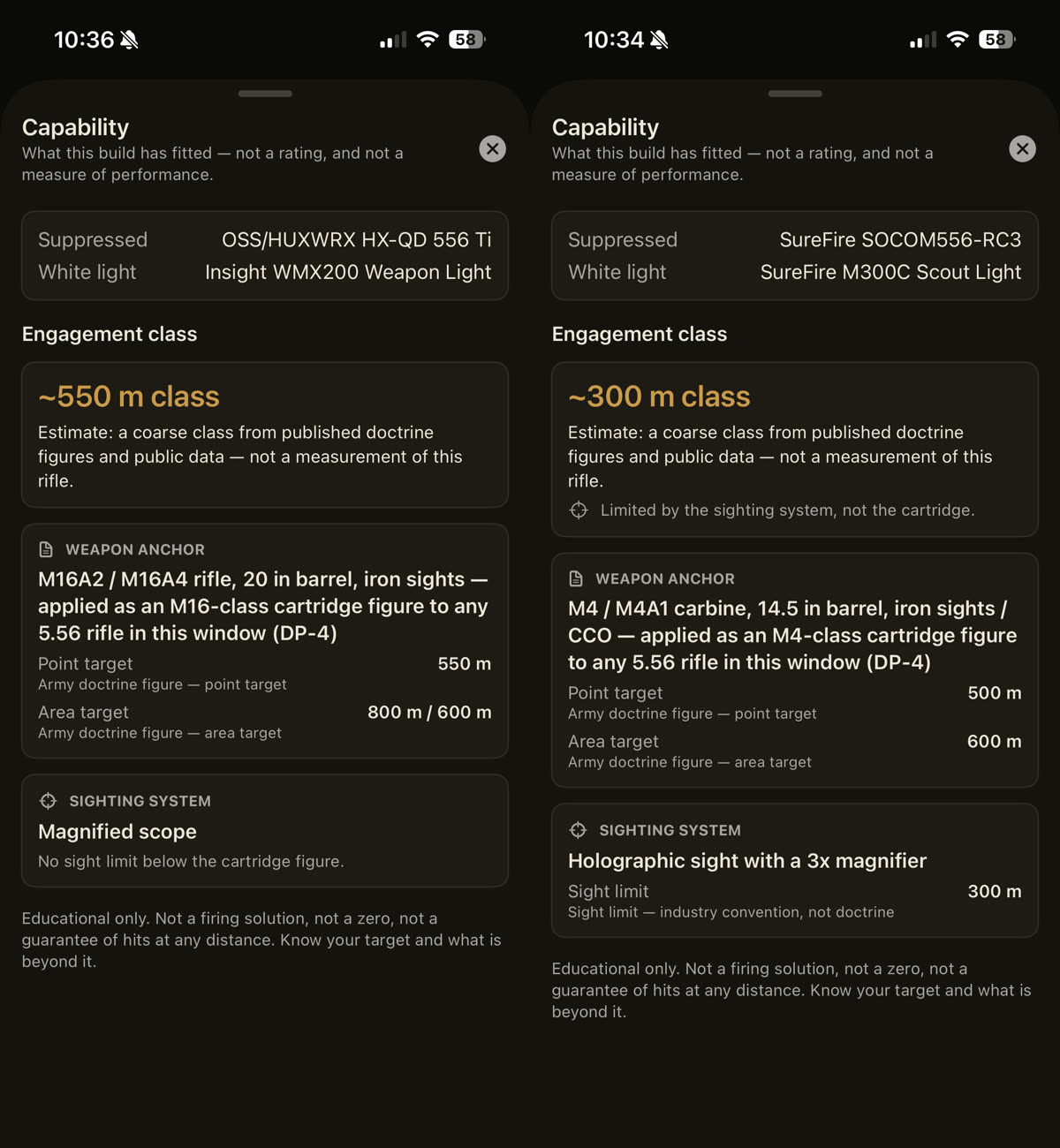
On the bench, a rifle build carries an engagement chip: a class such as "~500 m," or "Not estimated." The sheet behind it shows the anchor weapon, the point and area figures, the sighting system and its cap, and the sources by name and grade. Every figure is a verbatim row of a bundled table; nothing is computed per build, and doctrine figures are not rounded (the M14's 460 m stays 460).
Two sentences appear on every sheet, estimated or not. Under the class: "Estimate: a coarse class from published doctrine figures and public data — not a measurement of this rifle." And at the foot: "Educational only. Not a firing solution, not a zero, not a guarantee of hits at any distance. Know your target and what is beyond it."
The same class is carried, unchanged, into the Capability sheet beside two presence rows, Suppressed and White light, under the footnote "What this build has fitted — not a rating, and not a measure of performance." There is no score and no radar; the estimate reads only what is equipped.
FINAL THOUGHTS
An AR-15's range is not one number. With iron sights and a 20-inch barrel the Army expected a point-target hit at 550 meters; with a 14.5-inch barrel, 500. Below 12.5 inches doctrine goes quiet and convention says 300. Put a red dot on any of them and the honest figure is about 200, until you add magnification. Each of those figures has a definition and a citation. When the next spec sheet gives you a range, ask for both; if the answer is "it's the effective range," you have been given a number, not an answer.