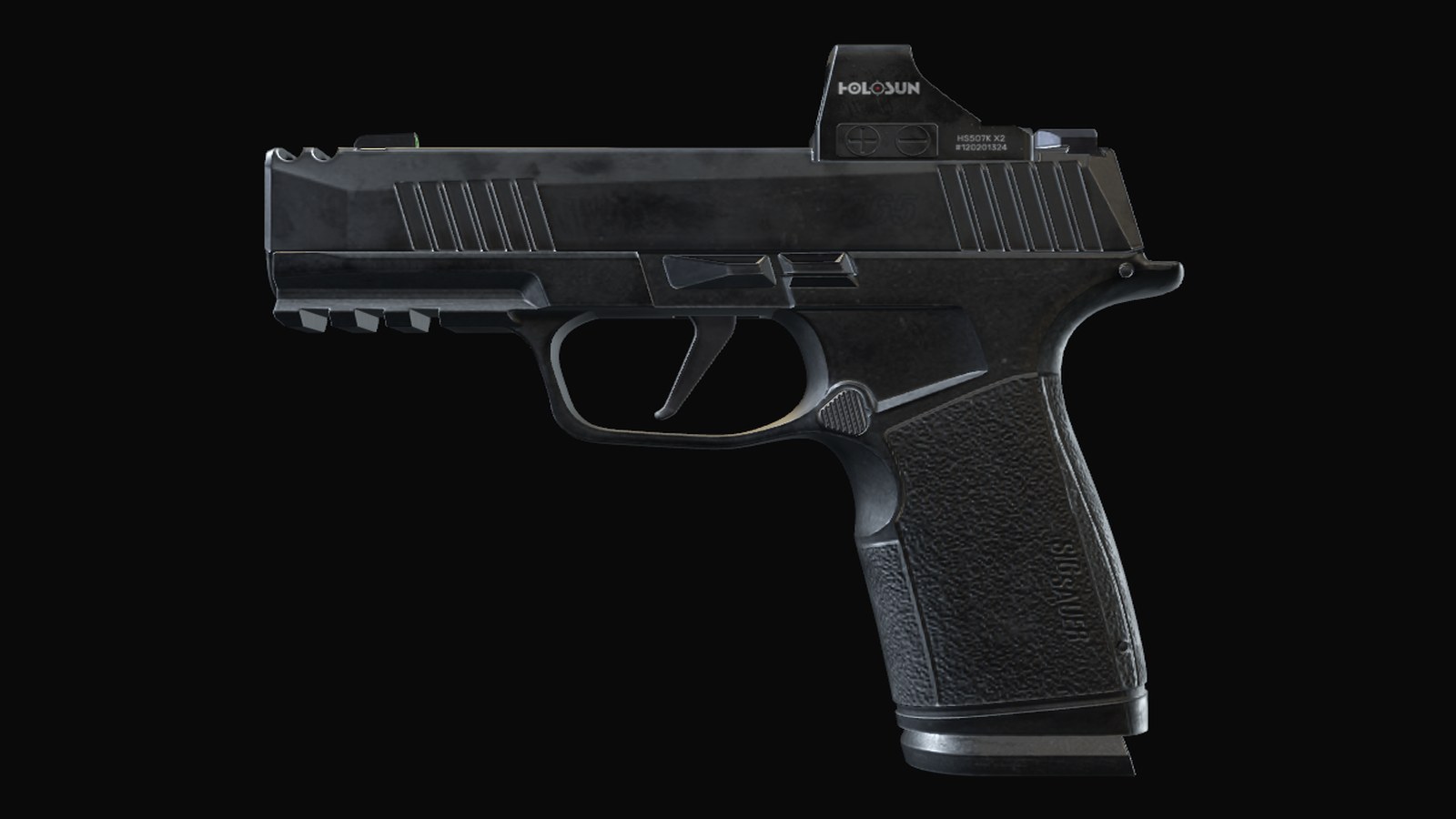
The P365-XMACRO is the P365 that stopped being a pocket gun. A 3.7-inch barrel, a 17+1 double-stack-width grip module, a standard 1913 accessory rail and a slide cut for RMSc-pattern optics put it in the same conversation as a compact duty pistol, at a listed MSRP of $799.99. That combination is also why it is such a good platform to upgrade: it has the rail and the optic cut that the smaller P365 variants lack, and it shares the P365 fire control unit, so most of the trigger and grip ecosystem carries over.
This guide covers the upgrades that change how the gun shoots, in the order most owners should buy them. Every product below is a real, named part, and every price was checked against the manufacturer or a major dealer at the time of writing. Where a price could not be verified, it is left out rather than guessed.
WHERE TO SPEND FIRST
If you only buy one thing, buy the optic. The XMACRO ships optic-ready, the cut takes the most common micro-dot footprint on the market, and a red dot changes the gun more than any other single part. A weapon light is second if the pistol has a home-defense role. A trigger is a quality-of-life upgrade, not a transformation, because the factory trigger on the X-series guns is already good. Grip modules, threaded barrels and magazines come after that.
THE OPTIC
The XMACRO slide is cut for the RMSc footprint — the same pattern SIG's own ROMEOZero uses — and the dot mounts directly to the slide. There is no adapter plate, which keeps the optic low and removes one interface that can work loose. Anything with a larger footprint, like a Trijicon RMR, does not fit this cut.
- Holosun 507K X2: The default choice, and the one most XMACRO owners end up with. Holosun lists it at $348.22; street prices sit around $300. It carries Holosun's K footprint, which mounts on the RMSc cut, a 2 MOA dot with a 32 MOA circle option, a 0.58 x 0.77 inch window, a side-loading CR1632 battery rated for 50,000 hours, and weighs 1 ounce. Shake Awake and a solar backup are standard.
- SIG ROMEOZero Elite: SIG's own micro dot for this cut, announced at $229.99 for the 3 MOA dot and $259.99 for the 2 MOA dot-and-circle version. It uses a polymer housing with a steel shroud and is the lightest option here. It is the budget pick, and it is what SIG ships on the factory ROMEOZero Elite package guns.
- Shield RMSc: The optic the footprint is named after. Shield lists the RMSc at $429.99 in 4 MOA and 8 MOA versions. It is the most expensive of the three and the thinnest-profile; buyers choose it for the low deck height and the glass edition lens.
Whichever you choose, plan on suppressor-height or co-witness iron sights only if you actually want to see irons through the window. The factory X-RAY3 sights sit low enough to stay out of the way of the dot on most of these optics.
THE LIGHT
The XMACRO's rail is a standard 1913 pattern, not the proprietary closed rail on the P365 and P365 XL. That matters when you buy a light, because several compact lights are sold in rail-specific versions.
- Streamlight TLR-7 sub: The right-sized light for this frame, around $150 to $160 depending on version. Streamlight now sells it as the TLR-7 X sub in a multi-fuel body, and it comes in fitment-specific versions: buy the 1913 short-rail version for the XMACRO, not the P365/P365 XL closed-rail version. Streamlight rates it at 550 lumens on a CR123A and 725 lumens on the rechargeable SL-B9 cell.
- SIG FOXTROT1X: SIG's compact rail light, listed at $129.99, 450 lumens on a single CR123 with ambidextrous side switches. It mounts to any 1913 or Glock-pattern rail with no adapter, so it fits the XMACRO without a fitment question.
- SureFire XVL2: The duty-grade option, and a different category of purchase at $1,799.00. SureFire lists 400 lumens of white light with co-aligned green and infrared lasers in a 3.0-inch, 5.0-ounce body. On a 3.7-inch carry pistol it is heavy and it extends to the front of the dust cover; it belongs on an XMACRO that lives in a nightstand or a duty role, not in an appendix holster. Note that the laser functions are outside what most owners need, and the price reflects them.
Verify your holster before you buy any of these. A light-bearing holster is a specific product for a specific light, and the XMACRO plus a TLR-7 sub is a common enough combination that the major holster makers already list it.
THE TRIGGER
SIG's X-Series flat trigger is a factory part on the X-series P365s. Look at the face of the trigger on your gun before buying anything: if it is already flat, the factory trigger is not the weak point it is on the base P365. If it is the curved trigger — an older fire control unit moved into an XMACRO grip module, for example — the SIG P365 Flat Trigger kit is the factory flat-face part at about $49.99.
- Armory Craft P365 Adjustable Flat Trigger: The aftermarket step up, listed at $89.95 and frequently on sale below that. Armory Craft lists it as compatible with every P365 model including the XMACRO. The value is the adjustability: you can set pre-travel and overtravel rather than accepting the factory geometry. It does not change the sear or the striker spring, so it is a feel change, not a pull-weight change.
Any trigger work on a carry gun should be installed by someone who knows the platform and function-checked afterward. This article does not cover installation.
THE GRIP MODULE
Because the P365 is a fire-control-unit gun, the grip module is a swappable accessory, and the XMACRO's 17-round grip module is the widest in the family.
- Wilson Combat WCP365 X-Macro Grip Module: Wilson Combat lists it at $77.95. It changes the texture and the trigger-guard undercut and adds a more contoured backstrap, and Wilson Combat lists it as fitting the XMACRO and XL. It is the one aftermarket module purpose-built for the XMACRO width. Note the manufacturer's caveat that its P365 modules are not compatible with California-configuration P365s.
SIG's own laser-engraved Spectre grip module ships on the Spectre Comp and is a factory part; it uses the same XMACRO grip footprint.
THREADED BARREL AND COMPENSATOR
Two versions of the XMACRO exist here: the standard XMACRO with a 3.7-inch barrel, and the XMACRO Comp with a 3.1-inch barrel and SIG's integrated compensator machined into the slide. What you should buy depends on which one you own.
- True Precision P365XL/XMACRO Threaded Barrel: True Precision lists its 1/2x28 threaded barrels for the 3.7-inch P365XL, XMACRO and XMACRO TACOPS at $179.99 to $199.99 depending on finish. True Precision is explicit that it is not for the XMACRO Comp slide. A threaded barrel is the prerequisite for a suppressor or a thread-on compensator.
If you own the XMACRO Comp, you already have a compensator. Do not stack a thread-on comp on top of it; the integrated comp is the feature you paid for, and the threaded-barrel route is for the non-comp gun.
A suppressor is an NFA item and requires a Form 4 and registration through a licensed dealer. As of January 1, 2026 the federal tax is $0, but registration is still required. Threaded barrels and compensators are also regulated differently in some jurisdictions, so verify your state law before buying either.
SIGHTS
- TruGlo TFX Pro: A tritium and fiber-optic combination sight set for the P365, listed by Palmetto State Armory at $136.99. It is a genuine improvement over plain three-dot sights if you run the gun without an optic. With a dot installed, the factory X-RAY3 set is fine and sits below the window; only swap to a taller set if you want a true co-witness.
MAGAZINES
- SIG P365-XMACRO 17-round magazine: The factory steel 17-rounder, listed by Primary Arms at $59.99 and often on sale. It is the magazine the gun was designed around and the only one you need more of. The 17-round XMACRO magazine does not fit the standard P365 or P365 XL grip modules — the grip is wider — so if you own more than one P365 variant, keep them separate.
Magazine capacity is regulated by state in several places. Verify your state law before ordering.
WHAT TO SKIP
The XMACRO has a large enough aftermarket that some of it is not worth the money.
- A second compensator on the XMACRO Comp, for the reason above.
- The P365/P365 XL closed-rail version of any light. The XMACRO's rail is different, and the closed-rail versions do not clamp to it.
- Grip tape on the XMACRO module before you have shot it. The factory texture is aggressive for a carry gun; try it first.
ON THE BENCH
Gear Guy lets you configure the P365-XMACRO in 3D from real named parts before you spend the money. Seat the Holosun 507K X2 on the RMSc cut, put a SureFire XVL2 on the rail, swap in the threaded barrel and see the whole build on screen. The compatibility engine reads the same catalog: it warns when an optic's footprint does not match the slide cut, when a light does not fit the rail, when a 17-round XMACRO magazine is paired with a standard grip module, and when a compensator or suppressor is added without a threaded barrel — and it tells you which part fixes the conflict.
When the gun is real, the Armory stores it in an AES-256-GCM encrypted vault on your device with no account and the serial masked by default, the range log tracks round counts and deducts ammunition, and the Capability sheet shows whether the build carries a white light and whether it is suppressed. Identify can read a photo of the gun and stand it up on the bench, and any build can be shared as a link at gearguyapp.com/b/.
FINAL THOUGHTS
Buy the 507K X2 first, a TLR-7 sub in the 1913 version second, and stop there until you have shot the gun enough to know what else you want. The Armory Craft trigger and the Wilson Combat module are real improvements for owners who have put rounds through the factory configuration and know what they are changing. The threaded barrel is a project decision, not an upgrade, and it comes with paperwork. The XMACRO is a good pistol out of the box; the best upgrades are the ones that add capability rather than replace what already works.