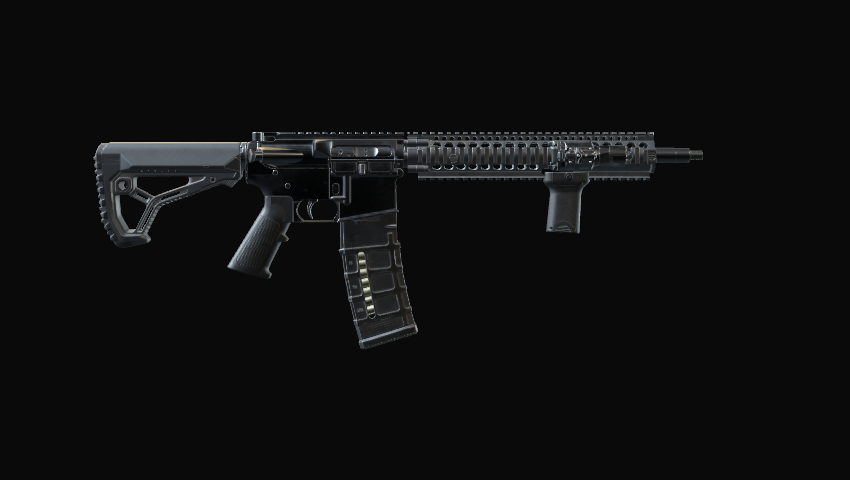
The handguard decides more about how an AR-15 handles than almost any other part you can change. It sets where your support hand lives, what you can mount and where, how much the front end weighs, and whether the barrel is free to vibrate on its own or is being touched by a piece of aluminum every time you grip the rifle. This guide covers the three decisions that matter — free-float or drop-in, M-LOK or quad rail, and length — and then ranks the handguard families that ship in Gear Guy's catalog under their real names, with prices checked against the manufacturer or a major dealer at the time of writing.
FREE-FLOAT VS DROP-IN
A drop-in handguard clamps between the delta ring behind the barrel nut and the handguard cap in front of the front sight base. It touches the barrel at both ends, it changes without a barrel-nut wrench, and it is the only style that works with a fixed A2 front sight tower on a carbine-gas barrel. The USGI double-heat-shield carbine handguard, the A2 rifle handguard and the Knight's Armament RAS quads are all drop-ins.
A free-float handguard mounts to its own barrel nut and touches nothing forward of it. The barrel hangs inside. That matters for accuracy — pressure from a sling, a bipod or your hand no longer pushes on the barrel — and it matters for mounting, because the rail runs uninterrupted to whatever length you buy. The cost is that the rail has to clear whatever is on the barrel. A free-float rail long enough to reach a fixed front sight tower cannot be fitted; the tower stands where the rail needs to pass. Daniel Defense's answer is the RIS II FSP, which windows the top rail so a carbine-gas A2 tower can stand through it. Everyone else's answer is a low-profile gas block.
Free-float rails also bring their own barrel nut, and not every nut is standard. Aero Precision's Enhanced handguards use Aero's BAR interface and, in Aero's own words, "do not work with a standard barrel nut". BCM, Geissele, Daniel Defense and KAC each ship a proprietary nut with the rail. Budget for it and check what your upper receiver accepts.
M-LOK VS QUAD RAIL
A quad rail carries Mil-Std-1913 Picatinny at 12, 3, 6 and 9 o'clock along its full length. Anything with a Picatinny clamp bolts on anywhere, which is why the SOPMOD Block II rifle wears a RIS II. The trade is weight and bulk: Daniel Defense's own figures put the RIS II 12.25″ at 17.7 oz and 2.23″ wide, and a bare quad rail is uncomfortable to hold without rail panels.
M-LOK replaces the side and bottom rails with slots. Accessories bolt directly into the slots with T-nuts, and short Picatinny sections go only where you need a clamp — a light, a bipod, a laser. An M-LOK rail of the same length runs lighter and a good deal slimmer. Every current-production handguard in this ranking except the RIS II and the two KAC RAS drop-ins is M-LOK. If you are buying new and not cloning a specific issue rifle, M-LOK is the default.
One caution: M-LOK accessories and Picatinny accessories are not interchangeable. A Picatinny-clamp foregrip does not mount to an M-LOK slot without an adapter section, and an M-LOK grip does not mount to a quad rail. Buy the accessory to match the rail, or buy the rail to match the accessories you already own.
LENGTH: MATCH THE BARREL AND THE GAS BLOCK
Rail length is a physical-fit question before it is a preference. The gas port sits at a fixed distance from the receiver — roughly 4″ for pistol-length gas, 7″ for carbine, 9″ for mid-length and 12″ for rifle-length, per Primary Arms' gas-system guide — and a free-float rail either stops behind the gas block or covers it. Covering a low-profile block is the normal modern configuration. Covering a fixed front sight base is impossible.
The second constraint is the muzzle. A rail that runs past the muzzle device blocks it, and a rail that stops well short leaves a stretch of bare barrel where nothing can mount. The usual pairings:
- 10.5″ and 11.5″ carbine barrels: a 9″ or 10″ rail covers the gas block and leaves the muzzle device clear. A 7″ rail on the 10.5″ is the compact option if you are keeping a fixed front sight or want the shortest package.
- 12.5″ barrels: a 12″-class rail. Gear Guy's 12.5″ carbine-gas barrel exists specifically so a 12.25″ RIS II ends just behind the flash hider.
- 14.5″ barrels: 13″ rails, whether mid-length or carbine-gas with a low-profile block. With a pinned-and-welded muzzle device the barrel measures 16″ and the rail still clears the device.
- 16″ barrels: 13″ to 15″. A 15″ rail on a 16″ mid-length is the standard long-rail carbine.
- 18″ and 20″ rifle-gas barrels: 15″ rails, or a rifle-length drop-in if the barrel carries an A2 front sight.
If you are keeping a fixed front sight base, the handguard is decided for you: a carbine drop-in, a RAS, or a RIS II FSP on carbine-gas; the A2 rifle handguard or a KAC M5 RAS on rifle-gas.
THE RANKING
Only handguards that ship in Gear Guy's catalog under a verified manufacturer name are ranked. Prices were checked on September 1, 2026 against the manufacturer's site or a major dealer; where a lineup has changed since a part was catalogued, that is noted.
1. BCM MCMR (7, 8, 9, 10, 13 AND 15 IN)
Bravo Company's M-LOK Compatible Modular Rail is the best value per ounce in the free-float M-LOK category and the one most people should buy first. Six lengths cover every barrel in this guide. BCM's own figures put the MCMR-13 at 8.2 oz for the handguard alone (plus 2.3 oz of mounting hardware) and the MCMR-15 at 9.2 oz. The rail indexes to the 12 o'clock receiver rail, which keeps the top rail aligned without fiddling, and the nut is one of the easiest of the group to live with. MSRP at bravocompanyusa.com is $220 for the MCMR-7 and MCMR-8, $225 for the 9, $230 for the 10, $240 for the 13 and $250 for the 15, with BCM's own selling prices about $13 to $15 under each MSRP. Black and flat dark earth.
2. GEISSELE SUPER MODULAR RAIL MK4
The MK4 is Geissele's mainstay M-LOK rail, mounted on Geissele's own barrel nut and offered in a wide spread of lengths. It runs somewhat heavier than the MCMR at a given length — the catalog carries the 13″ at 12.6 oz against BCM's 10.3 oz — and is stiffer for it, and the Desert Dirt Color and OD Green finishes are the reason half the clone rifles you have seen look the way they do. Gear Guy carries the 7, 9.5, 10, 13 and 15″ lengths. Pricing runs from about $275 for the 7″ at dealers to $400 for the 15″ at geissele.com. Note that Geissele's current site lists 9.3″ and 13.5″ where older production ran 9.5″ and 13″, so check the exact length before you order.
3. DANIEL DEFENSE M4A1 RIS II 12.25 IN (AND RIS II FSP)
The SOPMOD Block II rail. If you want the rifle the pictures show, this is the handguard, and the Bolt-Up barrel nut is as rigid a free-float mount as exists. It is a quad rail, so it is heavy — 17.7 oz — and it wants panels or covers to be comfortable. The standard RIS II has an unbroken top rail and needs a low-profile gas block; the FSP version windows the top rail so a carbine-gas A2 front sight stands through it, with the side and bottom rails running through unbroken. Daniel Defense lists the RIS II at $582; the FSP variant carries a $589.40 MSRP at dealers. Black and flat dark earth.
4. KNIGHT'S ARMAMENT URX-6 (10.5, 12.75 AND 15 IN)
KAC's current-generation M-LOK rail, and the one that ships on the SR-15 Mod 2. It is a slim, very rigid free-float on KAC's own barrel nut, with the fit and finish you pay Knight's prices for. Dealer MSRP is $302.40 for the 10.5″ (10.5 oz) and $324 for the 12.75″ (12 oz). Gear Guy also carries the 15″; a current price for that length was not verified at the time of writing.
5. AERO PRECISION ENHANCED M-LOK HANDGUARD, GEN 2 (7.3, 9.3, 12.7 AND 15 IN)
The budget pick, and a legitimately good one: one-piece free-float aluminum with a full-length top rail, M-LOK at 3, 6 and 9, and a QD sling socket built in. The catch is the mount. These use Aero's BAR barrel-nut interface and do not fit a standard barrel nut; on an Aero M4E1 Enhanced upper nothing else is needed, and on any other upper you buy the BAR nut with the rail. Aero lists the family at $135 to $250 depending on length (regular price $139.99 to $250). Anodized black and FDE Cerakote.
6. KNIGHT'S ARMAMENT M4 RAS AND M5 RAS
The drop-in quads. The M4 RAS (P/N 98064) is the 6.25″ SOPMOD Block I carbine rail that clamps between the delta ring and the handguard cap on a carbine-gas barrel with an A2 front sight — no barrel-nut swap. The M5 RAS (P/N 98065) is the 11.5″ rifle-length version, the M16A4 configuration. Knight's lists the M4 RAS at $312.05 (8.9 oz) and the M5 RAS at $346.61 (14.4 oz). They are not free-float and do not pretend to be; they are the correct answer if you are keeping the front sight tower and want rails.
NOT RANKED
Gear Guy also carries a USGI M4 double-heat-shield carbine handguard, the A2 rifle-length ribbed handguard, a generic 14″ M-LOK free-float, a Midwest Industries Combat Rail 15″ that renders as a representative model, and two HK416 handguards that mount only on HK's proprietary barrel nut. None of those is ranked: the first three are patterns rather than a manufacturer's product, the Midwest is shown on a stand-in model, and the HK416 rails belong to a different platform. Geissele's MK16 9.3″ is catalogued but rendered on a borrowed model, so it stays off the list as well.
HOW GEAR GUY HANDLES THE FIT
Every handguard above renders on the bench in 3D against the barrel you have equipped, so the rail-to-gas-block and rail-to-muzzle relationships are visible before you spend anything. The compatibility engine does the arithmetic behind the picture. Equip a free-float rail long enough to reach a fixed front sight base and it flags the pairing as a conflict — "the sight tower sits where the handguard needs to pass" — and suggests a shorter rail or a low-profile gas block barrel; it knows the RIS II FSP window and stays silent when the tower stands through it. Add a foregrip and then a light or laser and it warns when there is not enough rail space forward of the grip. Equip any free-float rail and it reminds you that the rail brings its own barrel nut. When a configuration is worth keeping, it saves to the Armory in the encrypted on-device vault and shares as a link at gearguyapp.com/b/.
FINAL THOUGHTS
Decide the barrel and gas block first, then the rail length, then the rail. For most new configurations that lands on a 13″ or 15″ M-LOK free-float, and the BCM MCMR is the one to beat on price and weight. Buy the Geissele for stiffness and finish, the RIS II because you want that rifle, the URX-6 because you are already in the KAC ecosystem, and the Aero because the budget says so. Keep a fixed front sight and the choice narrows to a drop-in, which is not a downgrade — it is the configuration those rifles were designed around.