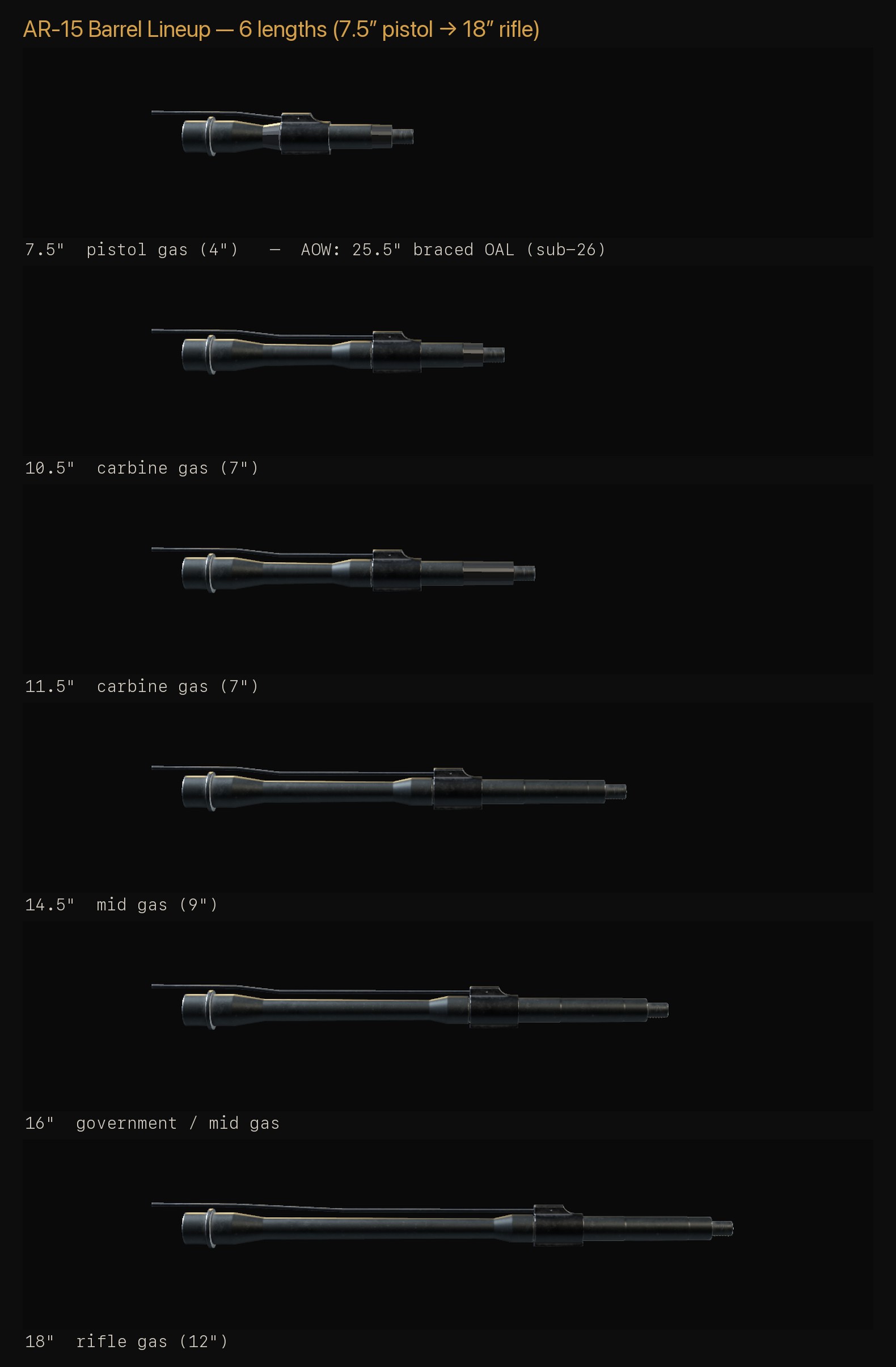
Barrel length is the one AR-15 decision that touches everything else: velocity, the gas system, which handguard fits, how the rifle balances, and whether the finished firearm is a rifle, a pistol or a registered short-barreled rifle. Gear Guy's catalog carries AR-15 barrels at ten lengths from 7.5″ to 20″, including HK416 piston barrels at 11, 14.5 and 16.5″. This guide goes length by length, with velocity numbers from a published cut-down test, the gas-system pairings, the federal rules as written, and the effective-range figures the military actually publishes — labelled by what kind of figure each one is.
WHAT AN INCH IS WORTH
The cleanest public data on 5.56 velocity versus barrel length comes from rifleshooter.com, which cut a single barrel down an inch at a time and chronographed it at each step. It is one barrel and five-round samples, and the author says so, but it is measurement rather than a manufacturer's claim. From 26″ to 16.5″ the loss is gentle: an average of 25.7 ft/s per inch for Federal M193 and 30.3 ft/s per inch for Winchester M855. The rifle-length numbers that matter for this guide:
- 20″: M855 3,097 ft/s; M193 3,306 ft/s. Army doctrine lists the M16A2's muzzle velocity at 3,100 ft/s, which this test reproduces almost exactly.
- 18″: M855 3,052 ft/s; M193 3,202 ft/s — about 1.5 percent under the 20″ on M855.
- 16.5″: M855 2,992 ft/s; M193 3,187 ft/s — about 3.4 percent under the 20″ on M855.
Below 14″ the curve steepens. The same author's short-barrel test, 14″ down to 6″, measured an average loss of 104.6 ft/s per inch for Federal XM193 and 87.5 ft/s per inch for Winchester M855. That is three to four times the per-inch cost of the rifle-length range, and it is why a 10.5″ barrel behaves like a different cartridge from a 20″ one.
So 16″ versus 20″ is a small velocity argument and a large handling argument, while 10.5″ versus 12.5″ is not small at all: at M855's short-barrel rate, two inches is about 175 ft/s.
GAS SYSTEM PAIRING
The gas port sits at a fixed station from the receiver, and the barrel length decides how much barrel remains past it — the dwell. Too little and the rifle is undergassed and short-cycles; too much and it is overgassed, harsh and hard on parts. Primary Arms' gas-system guide gives the port distances and the barrel ranges each system is built for:
- Pistol-length (port about 4″): barrels under 10.5″. The catalog's 7.5″ barrel runs pistol gas.
- Carbine-length (port about 7″): 10.5″ to 16″. The catalog's 5.56 barrels at 10.5, 11.5 and 12.5″ run carbine gas, as do the two 14.5″ M4-profile barrels — one with an A2 front sight base, one with a low-profile gas block.
- Mid-length (port about 9″): 14.5″ to 20″. The catalog's 14.5″ and 16″ government-profile barrels run mid-length gas, the softer-shooting choice at those lengths and the current default for a new 16″ configuration.
- Rifle-length (port about 12″): 18″ and up. The 18″ and both 20″ barrels run rifle gas, and so does the 16″ SPR-profile barrel — a rifle-gas 16″ has very short dwell and is a precision configuration, not a general-purpose one.
The HK416 barrels are a different system entirely: a short-stroke gas piston on HK's proprietary barrel nut, at 11, 14.5 and 16.5″, in the original and the A5 adjustable-gas generations. They fit HK416 uppers and nothing else.
The gas system also decides the handguard: a carbine-gas block at about 7″ takes a 7″ rail behind it or a 9″-plus rail over it, a mid-length block at about 9″ wants 13″ or 15″, and a fixed A2 front sight takes only a drop-in or a windowed rail like the RIS II FSP.
THE 16-INCH LINE
Federal law, not preference, sets the most important number on this list. The National Firearms Act defines a "firearm" to include "a rifle having a barrel or barrels of less than 16 inches in length" and "a weapon made from a rifle if such weapon as modified has an overall length of less than 26 inches or a barrel or barrels of less than 16 inches in length" (26 U.S.C. § 5845(a)(3) and (a)(4)). A rifle — a firearm with a stock, designed to be fired from the shoulder — with a barrel under 16″ is a short-barreled rifle and must be registered before it is made or transferred. Making one is an ATF Form 1; buying one from a dealer is a Form 4. As of January 1, 2026 the federal tax is $0, but registration is still required.
How the 16″ is measured matters as much as the number. Per ATF's National Firearms Act Handbook, barrel length is measured by inserting a rod into the bore until it stops against the bolt face with the action closed, then measuring to the end of the barrel or of a permanently attached muzzle device. Permanent means full-fusion welding, silver solder with a melting point of at least 1,100 °F, or a blind pin with the head welded over. That is why a 14.5″ barrel with a pinned-and-welded flash hider is a 16″ barrel in the eyes of the law, and why the same barrel with a threaded-on device is not.
A firearm with no stock, made as a pistol from the start, is not a rifle, and the 16″ rule does not apply to it — which is what the 7.5, 10.5, 11.5 and 12.5″ barrels are for outside a registered SBR. What you attach to a pistol has its own rules: a vertical foregrip on a pistol makes it an "Any Other Weapon" under ATF's longstanding interpretation of the National Firearms Act, and it too must be registered on a Form 1 before the grip goes on. As of January 1, 2026 the federal tax is $0, but registration is still required. This guide covers federal law only. Verify your state law before you buy or configure; states regulate barrel length, overall length and pistol features independently.
HOW FAR: THE PUBLISHED FIGURES, AND WHAT KIND THEY ARE
"Effective range" is quoted constantly and defined rarely. Two different quantities share the phrase. A hit-probability figure — the "maximum effective range" in Army doctrine tables — is the distance at which a trained shooter is expected to hit a point target (one person-sized target) or an area target. A terminal-ballistics figure is the distance at which a specific load still fragments or penetrates to a standard. They are not interchangeable, and a finer number under the second definition is not a better answer to a question about the first. The figures below are hit-probability figures from doctrine, plus one industry convention, because those are what is actually published for the AR-15's barrel lengths.
- 18″ to 20″ (M16A2 / M16A4 class): 550 m point target; 800 m area target for the M16A2/A3, 600 m for the M16A4. Source: FM 3-22.9 Rifle Marksmanship (2008), Table 2-1, and TM 9-1005-319-10 (2010). The two manuals disagree on the area figure and both are carried.
- 14.5″ to 16″ (M4 / M4A1 class): 500 m point target; 600 m area target. Same sources. A 16″ barrel sits between the M4's 2,970 ft/s and the M16A2's 3,100 ft/s doctrine velocities and takes the lower, M4-class figure.
- 10.3″ to 12.5″ (Mk 18 / M4 Commando class): about 300 m practical effective range. This is not doctrine; no Army table or manufacturer sheet publishes a figure at this length. It is the industry convention recorded for the Colt M4 Commando — "practical effective range is 200 to 300 meters" — at weaponsystems.net.
- Under 10.3″: no published figure. Doctrine stops at the M4 and the convention stops at the Commando class. A 7.5″ barrel has no honest number attached to it, and the velocity data above says why.
These are the definitions and sources, not a promise about your rifle or your marksmanship. What they do say is that a 16″ and a 20″ barrel differ by about 50 m of doctrine range, and that the drop from 14.5″ to 10.5″ is not a step but a different class.
WHAT EACH LENGTH ACTUALLY BUYS YOU
7.5 IN (PISTOL GAS)
The shortest common AR-15 barrel, and the one with the least to recommend it beyond size. Velocity is far down the steep part of the curve, muzzle blast and flash are severe, and no published effective-range figure exists for it. It is a pistol or a registered SBR by definition.
10.5 IN AND 11.5 IN (CARBINE GAS)
The Mk 18 and CAR-15 class lengths, with about 300 m of practical range by convention. The 11.5″ is the more forgiving of the two — a full extra inch of dwell on the same carbine gas port — and it is the length to choose unless the last inch is genuinely the point. Both are pistols or SBRs. The catalog carries the 11.5″ both with an A2 front sight base and with a low-profile gas block.
12.5 IN (CARBINE GAS)
The length that pairs with a 12″-class free-float rail — a 12.25″ RIS II ends just behind the flash hider — and the top of the short-barrel convention at about 300 m. Still under 16″: pistol or SBR.
14.5 IN (CARBINE OR MID-LENGTH GAS)
The M4's length, and the length behind the 500 m doctrine figure. With a pinned-and-welded muzzle device it is a legal 16″ rifle barrel; without one it is an SBR. Besides the two HK416 piston barrels, the catalog carries it three ways: mid-length gas with a low-profile block, and M4-profile carbine gas with either an A2 front sight (the issue configuration) or a low-profile block.
16 IN (MID-LENGTH OR RIFLE GAS)
The default. It clears the 16″ line with a threaded, removable muzzle device, it carries the M4-class 500 m figure, and on M855 it gives up about 3.4 percent of a 20″ barrel's velocity. Mid-length gas is the standard pairing; the SPR-profile rifle-gas version is a heavy precision barrel for a designated-marksman-style configuration.
18 IN (RIFLE GAS)
The Mk 12 SPR length. Rifle-length gas at 18″ gives a soft impulse, and the barrel is inside the M16-class window — 550 m point, 800 m area — at about 1.5 percent under the 20″ on M855. The catalog carries a government-profile 18″ and an 18″ Mk 12 SPR-profile with the suppressor alignment collar ahead of the gas block.
20 IN (RIFLE GAS)
The M16A2/A4 barrel, the top of the velocity data at 3,097 ft/s on M855, and the 550 m / 800 m doctrine figure. It is long, it balances forward, and it is what the cartridge was designed around. The catalog carries it with the A2 front sight and delta ring, and with a low-profile gas block for free-float rails.
IN GEAR GUY
The barrel slot is a visual length variant: switch from 10.5″ to 20″ on the bench and the muzzle, the gas block and the handguard relationship redraw in 3D, so you see whether the rail clears the muzzle device or the front sight before you buy either. The compatibility engine flags a free-float rail that would reach a fixed front sight base and warns when an accessory has no rail space forward of the foregrip. The Capability sheet shows a configuration's suppressed and white-light rows; the Armory keeps the parts you own in the encrypted on-device vault with serials masked by default; and a saved configuration shares as a link at gearguyapp.com/b/.
FINAL THOUGHTS
Buy 16″ unless you have a specific reason not to, and know what the reason costs. Going shorter costs velocity at three to four times the rifle-length rate, costs the registration process below 16″, and costs the published effective-range figure entirely below 10.3″. Going longer buys a little velocity, a softer gas system and a rifle that balances differently. Pair the gas system to the length, pair the handguard to the gas block, and measure the barrel the way ATF measures it before you assume which side of the line you are on.