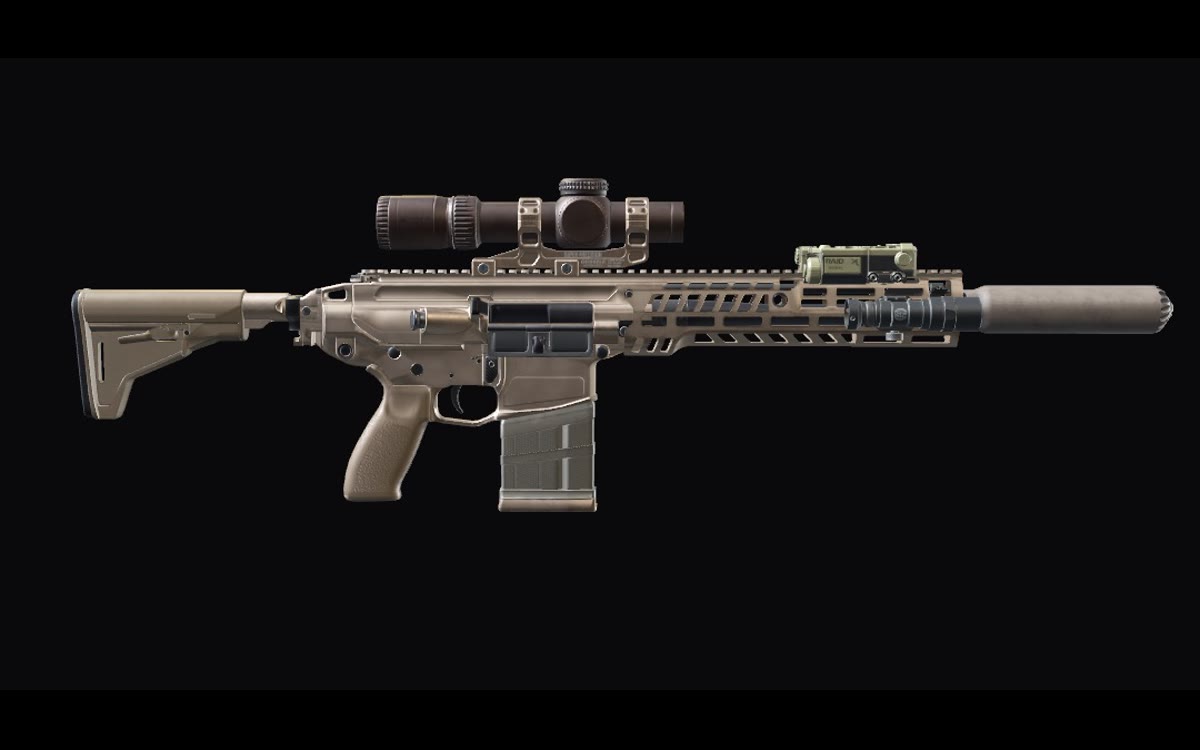
.300 AAC Blackout was designed around a suppressor, not adapted to one. The cartridge exists to deliver .30-caliber bullets from a short barrel through a standard AR-15 bolt and magazine, and to do it quietly when you load it subsonic. Every other rifle cartridge you might suppress was designed for something else first. This article covers what subsonic and supersonic actually mean with cited numbers, why the barrel length is short by design, which .300 BLK hosts and .30-caliber cans ship in the Gear Guy catalog, what the bore rule protects you from, and the one safety fact every .300 BLK owner has to internalize.
SUBSONIC VS SUPERSONIC
The dividing line is the speed of sound, which in dry air at sea level and 68°F is about 1,125 feet per second. A bullet above that speed produces a sonic crack along its whole flight path, and no suppressor can remove it; a suppressor only quiets the muzzle. A bullet below it produces no crack, so a subsonic round through a good can is limited by the mechanical noise of the action and the muzzle report the can leaves behind.
.300 BLK runs on both sides of the line with factory ammunition, and that is the whole trick. Two loads from one manufacturer show the spread. Hornady lists its 300 Blackout 190 gr Sub-X Subsonic at 1,050 feet per second from a 16-inch test barrel, producing 465 foot-pounds at the muzzle. Hornady lists its 300 Blackout 110 gr V-MAX BLACK at 2,375 feet per second from the same 16-inch test length. Same rifle, same magazine, a 1,300-foot-per-second difference in what comes out.
Treat those as manufacturer-published figures from a test barrel. Your barrel, your temperature, and your altitude will move them. The subsonic number in particular sits about 75 feet per second under the sound barrier at standard conditions, and a hot day, a longer barrel, or a fast lot of ammunition can push a nominally subsonic load across it. If the point is quiet, chronograph your load in your rifle.
WHY THE BARREL IS SHORT BY DESIGN
The cartridge's design brief is public. It was designed "to achieve energies similar to the 7.62×39mm Soviet in an AR-15 while using standard AR magazines at their full capacity," and to provide "effective subsonic performance for silencer use when compared to 5.56 mm NATO." The mechanical requirement was that an AR-15 needed "only a simple barrel change" to run it.
The 9-inch figure comes from the people who designed it. Writing in 2014 after conversations with the cartridge's developers, one industry writer put it in one sentence: "For 300 AAC Blackout, that point is 9 inches of barrel." The point in question is the length at which additional barrel stops adding meaningful velocity, because the powder charge is sized for a short tube. That is not a claim that every grain has burned by 9 inches; it is a diminishing-returns figure, and it is why a 9-inch .300 BLK carbine gives up almost nothing to a 16-inch one on subsonic loads and only a modest amount on supersonic.
The practical consequence is a rifle that is as short as a 5.56 SBR with a can on it, but quieter and with a heavier bullet. A manufacturer's range guide frames the two loads in effective-range terms, and the definitions matter: it gives supersonic .300 BLK a "maximum effective range: 200-300 yards" and subsonic "100-200 yards," and notes an 8-inch barrel is "ideal for subsonic loads" while a 16-inch barrel "maximizes supersonic velocity." Those are industry-convention figures, not doctrine, and the app's engagement-class table carries the supersonic figure at 300 meters for 8- to 16.5-inch barrels on that basis, with no figure at all below 8 inches because none has been published.
THE HOSTS IN THE CATALOG
Gear Guy models .300 BLK on the SIG MCX platform, where the caliber is a factory option rather than a conversion, and on the AR-15 as a representative 10.5″ pistol-gas barrel.
- MCX 9" Barrel .300 BLK: SIG's 9-inch .300 BLK barrel and gas block assembly for the MCX Spear LT, threaded 5/8x24. A major dealer lists the factory assembly at $895. This is the design-point length and the one to configure first.
- MCX Rattler 5.5" Barrel .300 BLK: The Rattler's 5.5-inch barrel, the shortest .300 BLK host in the catalog. It is a subsonic-first length; supersonic loads lose velocity fast below 9 inches. Price not verified at the time of writing.
Both barrels are tagged as under 11 inches in the app, which triggers a warning if you pair them with a low-power variable optic, and while no suppressor is on the build, both bring up the .300 BLK tip: ".300 BLK is ideal for suppressed shooting. Consider adding a suppressor such as the SIG SRD762-QD." Add the can and that tip gives way to the MCX-specific reminder: "Set the MCX's adjustable gas regulator to the suppressed position when running a suppressor to reduce bolt velocity and wear."
The legal side is the same as any short barrel. A 9-inch or 5.5-inch barrel on a stocked MCX is a short-barreled rifle, and the app's NFA education sheet flags it. As of January 1, 2026 the federal tax is $0, but registration is still required. A braced MCX is a different question, and the app's copy says exactly how unsettled it is; verify current ATF guidance and your state law before you rely on either configuration.
CHOOSING A CAN FOR .300 BLK
A .300 BLK host needs a .30-caliber can. That sounds obvious and is the single most important line in this article, because the cartridge lives in the same magazines and the same lowers as 5.56, and a dedicated 5.56 suppressor will thread onto a .300 BLK barrel without complaint. The bore is the problem: a .308-inch bullet through a .22-caliber-bored can is a baffle strike on the first round.
Gear Guy's bore rule is written for exactly this. It checks that the barrel's caliber is a member of the suppressor's rated set and reads, when it fails: "This suppressor is not rated for the barrel's caliber — firing risks a baffle strike." On the MCX it also catches a 5.56-only SIG can on a .277 Fury or 7.62 barrel. The reverse, a .30-caliber can on a 5.56 barrel, is safe and stays silent.
The .30-caliber cans in the catalog with verified names and prices, all rated for .300 BLK by their makers:
- SIG Sauer SRD762-QD: The MCX's own can, Inconel 718, 17 oz, 7 inches, Taper-Lok fast-attach, "rated up to 300 Win Mag and any other rifle cartridges that are of equal or less projectile diameter, pressure and case capacity," which includes .300 BLK. Around $750 at a major dealer, with one 5/8x24 Taper-Lok brake included. It mounts only over a SIG Taper-Lok device, and the app enforces that.
- Dead Air Sandman-S: 17.7 oz, 6.8 inches, rated to .300 RUM and full-auto rated, KeyMo quick-detach. MSRP $999.
- Dead Air Nomad-30: 14.5 oz, 6.5 inches, rated to .300 Norma Magnum, ships direct thread 5/8x24 with KeyMo and Xeno as options. MSRP $949, seen at $799 from a major dealer. The lightest of the three and the one that does not commit you to a mount on day one.
- CGS Hyperion: Titanium, 9.5 inches, 17.3 oz, 5/8x24 direct thread, full-auto rated from 5.56 through .300 RUM. Around $1,379. The long option for a dedicated subsonic host where sound reduction is the whole goal.
- Rugged Razor 7.62: 15.3 oz, 6.4 inches, rated to .300 RUM, full-auto and belt-fed rated, Dual Taper quick-detach with the M2 Brake included. Around $715.
One caution on multi-caliber flow-through cans: check the manufacturer's rated-caliber list for .300 BLK by name. HUXWRX's FLOW 762 Ti page lists 5.56, 6.5, and 7.62 platforms without naming .300 BLK, and a subsonic .30-caliber load behaves differently from a supersonic 7.62 one inside a flow-through core. If the maker does not list it, ask before you buy.
A subsonic load through a .30-caliber can on a 9-inch barrel is one of the quietest centerfire rifle configurations available, and it is quiet because of three separate choices lining up: a bullet that never breaks the sound barrier, a barrel sized to the charge, and a can bored for the bullet. Remove any one of them and the pairing stops working.
THE SAFETY NOTE
.300 BLK ammunition will chamber in a 5.56 rifle. The case is a shortened, necked-up 5.56 case, the overall length of many loads lets the bolt close, and nothing about the magazine, the bolt, or the lower will stop you. Firing it puts a .308-inch bullet into a .224-inch bore.
The Sporting Arms and Ammunition Manufacturers' Institute lists .300 AAC Blackout in a .223 Remington chamber as an unsafe combination. One rifle manufacturer that has received several destroyed rifles back from customers describes the failures, including a case where the bullet jacket separated from the core, and its guidance is the shortest version of this section: "match your ammunition to the markings on the barrel."
The practical rules are simple and non-negotiable. Keep .300 BLK and 5.56 ammunition physically apart, never on the same bench. Dedicate and mark magazines to one caliber. If you own both uppers, do not run both on the same day without a deliberate process for clearing the bench between them. A .300 BLK load in a 5.56 chamber does not feel different until the trigger breaks.
WHERE THIS LIVES IN GEAR GUY
The MCX in the app carries both .300 BLK barrels and the SRD762-QD as named parts, so you can visualize the exact configuration before you buy the pieces. The compatibility engine runs the bore rule, the Taper-Lok mount rule, and the exposed-muzzle rule on every change, and the NFA sheet flags the stocked short barrel without blocking it. The Capability sheet shows the build's suppressed row so a configured rifle reads as suppressed at a glance.
The range log is the feature that earns its keep on a .300 BLK rifle specifically. Because subsonic and supersonic are two different ammunition stocks, logging a session with round counts and ammunition deduction keeps track of which one you are running low on, and how many rounds the can and the barrel have seen. Both the rifle and the suppressor live in the Armory, an AES-256-GCM encrypted vault on your device with no account and serial numbers masked by default.
FINAL THOUGHTS
.300 BLK is the rare cartridge whose reason for existing is the suppressor. Configure the 9-inch host, put a .30-caliber can on the mount system you can live with, run subsonic ammunition when quiet is the goal and supersonic when reach is, and keep the two calibers apart with the discipline of someone who has read the safety section twice. Register the short barrel, verify your state law, and let the app catch the bore mismatch before the range does.